EN
EN PL
PL ES
ES


Publication date: 20-04-2025 | Update date: 17-04-2025 | Author: Piotr Kurpiewski

-
Online courses
- All
 3ds Max
 AI - Artificial Intelligence
 Blender
 Corona renderer
 GstarCAD
 LayOut
 Photoshop
 Interior Design
 Revit
Revit Sketchup
 Stable Diffusion
 V-ray
V-ray
"Online courses" are comprehensive online training programs that will help you quickly master the software you are interested in.
- Plugins
- 3D Models
- Help
- Articles
Virtual furnishing with AI: How GPT is changing the way interiors are designed
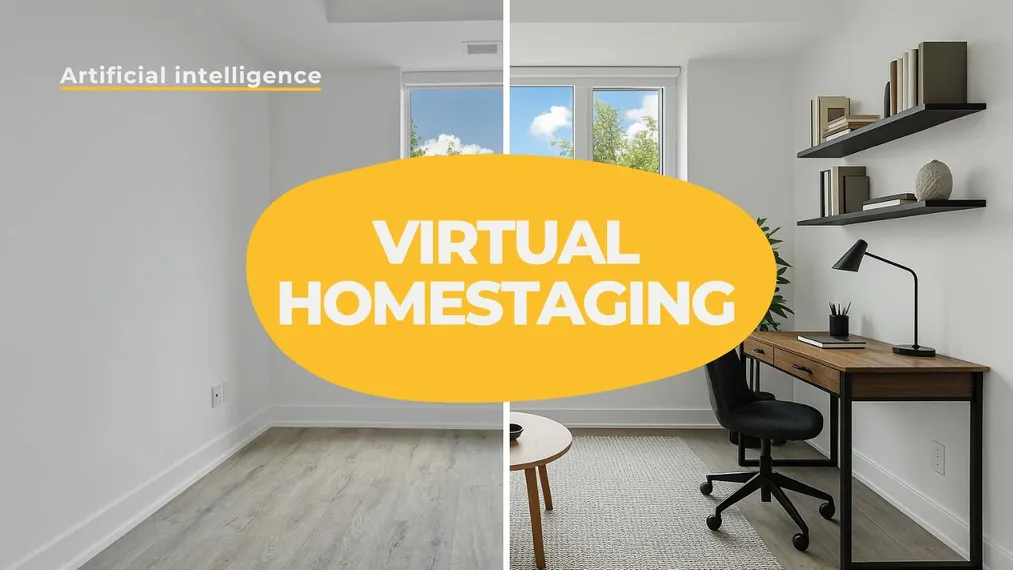
GPT-4o enables rapid virtual furnishing of interiors based on a photo or a 3D program view. Thanks to artificial intelligence, one can quickly test different styles, layouts, and accessories without modeling or rendering. The tool proves useful for both professional designers and amateur home decorators. The article demonstrates how to best prepare the input image and the effects to expect. It's a practical introduction to the modern approach to interior design with the help of AI.
Index
Just a short term ago, creating interior arrangements required knowledge of 3D software, patience for modeling, and time for rendering. Today just one photo and a few words of description are enough for GPT-4o to generate a ready-made proposal for a furnished interior.
Virtual furnishing with the help of artificial intelligence is becoming a real tool for both professionals and hobbyists. In this article, I will show how it can be used at different stages of work on a project, as well as what to avoid to ensure a truly satisfying end result.
Furnishing as a testing stage - how to quickly create presentations with AI?
Virtual furnishing with GPT-4o proves useful not only when preparing an aesthetic visualization for a client. It is also a fantastic tool for quickly testing ideas - changing the arrangement of furniture, styling walls, adding decorations, or adapting the functional layout to specific square footage.
Thanks to the capabilities of GPT, you can see in a few seconds how the atmosphere of an interior changes after adding color, plants, curtains, or completely different furniture styles. Without rendering and without modeling.
Changing the layout and style of an image with artificial intelligence
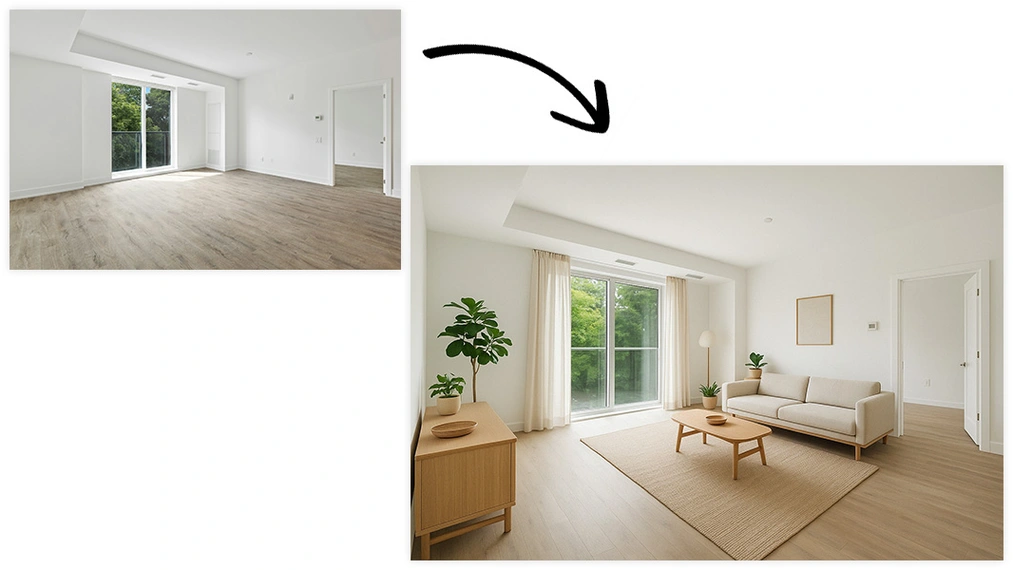
GPT-4o allows for very intuitive editing of existing views. For example, you can upload a photo of an empty living room with a caption: “Add modern japandi-style furniture, light wood, and a beige sofa. Linen curtains and potted plants.”
As a result, you will receive a stylized version of the same space - perfect for quickly presenting the concept to a client or testing different arrangement options.
How to adapt the image to different lifestyles and tastes with AI?
An undeniable advantage of AI is that it can work “on demand”. Simply indicate the user's characteristics (e.g. a family with children, freelancer, senior) or a specific interior style (industrial, eclectic, Scandinavian), and GPT will analytically adjust the arrangement to specific needs.
This tool is great not only for professionals, but also for those who are just starting out in design and want to “see how it can look” without having to learn complicated 3D software.
The use of AI in professional and amateur work
For interior architects and designers, GPT-4o can be a support in creating concepts or workshop work with clients - a screen capture from a design program or even a photo from a construction site is enough to create a preliminary vision of the space.
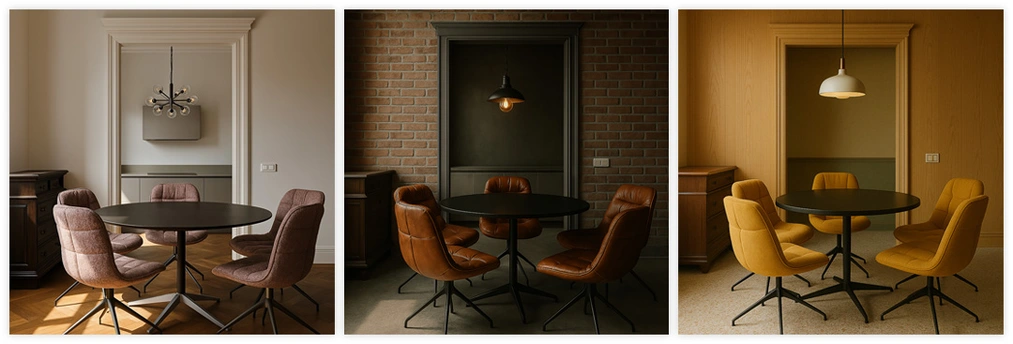
For hobbyists or individuals furnishing their own apartment, GPT-4o can be a tool for exploration - testing different style options, checking functional layouts, or simply playing with forms. Without knowledge of 3D programs, but with a quick visual result.
How to prepare an image so that GPT does a good job?
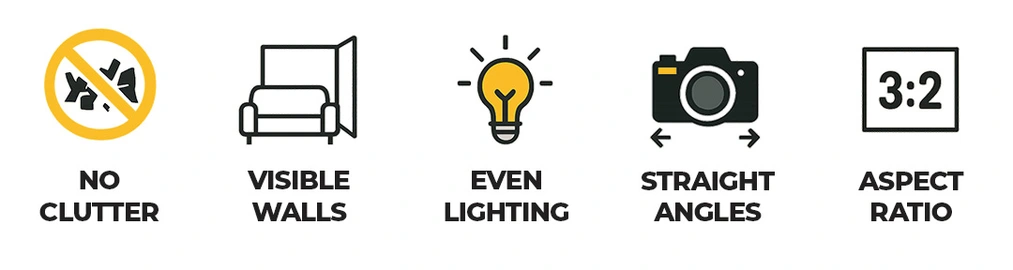
The quality of the final result depends largely on the input image. Poor input leads to poor output according to the principle of trash in - trash out. GPT-4o can handle various images, but the better prepared they are, the greater the chance of a coherent and aesthetic result. Here are a few practical rules:
- No clutter in the frame - the cleaner the interior, the easier it is for AI to interpret and replace it with appropriate elements.
- Well-visible walls - it is best if at least two walls and the floor are visible. This gives spatial context to the artificial intelligence.
- Even lighting - bright, natural light (e.g. a photo taken during the day) allows GPT to better recognize colors and shapes.
- No perspective distortions - do not take photos from a very low or very high position.
- Format - square photos (1:1) work best, but GPT also handles proportions of 3:2, 4:3, or 16:9.
By following these rules, you increase the chance that GPT-4o will generate not only a stylish, but also a logically organized and realistic arrangement.
Strengths and weaknesses of GPT in interior design
Virtual furnishing with the help of GPT-4o opens up new possibilities in interior design - both for professionals and for inexperienced individuals. Thanks to its simplicity and speed, this tool is excellent as a complement to traditional methods of work, especially in the concept creation and client communication stages. However, it is important to remember that GPT has its limitations, which means that it cannot fully replace traditional design tools yet. Below you will find a brief summary of its major strengths and limitations.
Advantages:
- Instant visualization of concepts without rendering,
- Flexibility of style and functions - interiors “on demand”,
- Accessibility for individuals without technical knowledge,
- Great support in the concept and inspiration stages.
Limitations:
- Lack of precise control over specific furniture or details,
- Unpredictability in the placement of elements in space,
- Not suitable for final investment or catalog visualizations.
Summary
Virtual furnishing with the help of GPT-4o is an incredibly interesting and dynamically developing tool that can already relieve designers and help hobbyists make interior design decisions. It works quickly, effectively, and intuitively - and in combination with a creative approach, it can truly amaze.
If you are interested in the use of AI in interior design, check out our AI course - Artificial Intelligence in Interior Design. You will find practical examples, tools, and advice that will help you make even better use of new technologies.
Author

Przeczytaj o programie AI - Artificial Intelligence na naszym blogu
-
![Virtual staging and AI photos in real estate listings - what does the AI Act change?]()
Virtual staging and AI photos in real estate listings - what does the AI Act change?
The AI Act vs real estate. Does virtual staging require an AI label? Find out how to avoid legal pitfalls and properly label photos. -
![How to Label AI Content According to the Law? Ready-Made Formulas for Designers and Archviz Studios.]()
How to Label AI Content According to the Law? Ready-Made Formulas for Designers and Archviz Studios.
How to Legally Label AI Visualizations? Check When a Label Is Mandatory and Copy Ready-Made Formulas for Your Projects. -
![Do you have to label visualizations as AI? What does the AI Act really say and what changes on August 2, 2026?]()
Do you have to label visualizations as AI? What does the AI Act really say and what changes on August 2, 2026?
AI Act from August 2! Do you have to label 3D visualizations as AI? Check where the legal boundary lies between concept and deepfake. -
![AI for furniture manufacturers - See how to create furniture packshots and catalog arrangements with raya.design]()
AI for furniture manufacturers - See how to create furniture packshots and catalog arrangements with raya.design
Packshots without time-consuming sessions? Discover Raya Design. Change upholstery and create arrangements with AI in moments. See how it works!