EN
EN PL
PL ES
ES


Publication date: 21-11-2025 | Update date: 21-11-2025 | Author: Mateusz Ciećwierz

-
Online courses
- All
 3ds Max
 AI - Artificial Intelligence
 Blender
 Corona renderer
 GstarCAD
 LayOut
 Photoshop
 Interior Design
 Revit
Revit Sketchup
 Stable Diffusion
 V-ray
V-ray
"Online courses" are comprehensive online training programs that will help you quickly master the software you are interested in.
- Plugins
- 3D Models
- Help
- Articles
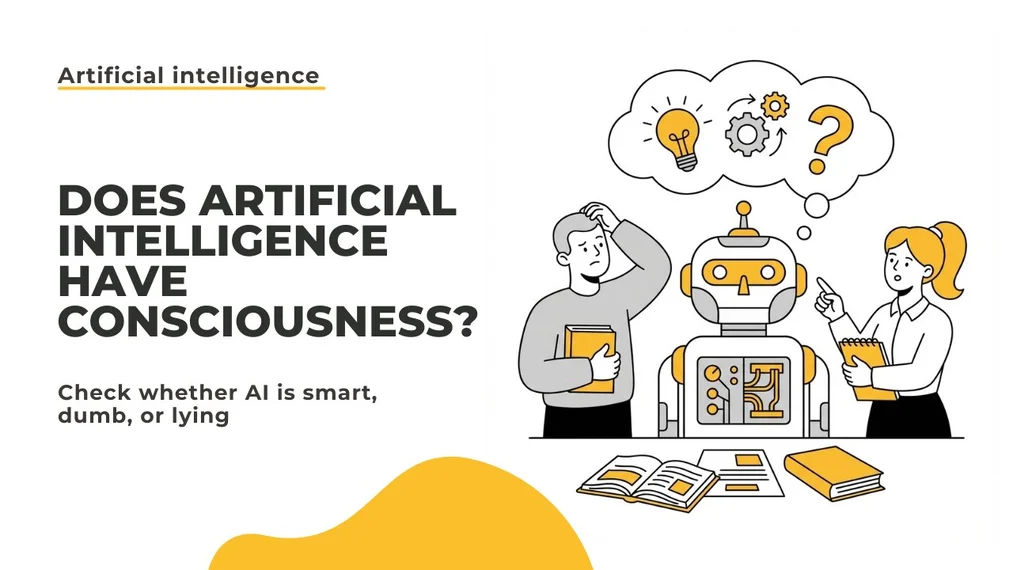
Does artificial intelligence have consciousness? We check whether AI is smart, stupid, and whether it lies
Does artificial intelligence have consciousness? Does artificial intelligence tell the truth, or could it lie? Or maybe it’s stupid or exceptionally smart? These questions are appearing more and more often, showing how much the development of artificial intelligence inspires fascination and concern. We decided to look into these issues and answer the questions about AI consciousness that concern you the most.
Index
Does artificial intelligence have consciousness?
Let's start with the simplest answer: No, artificial intelligence does not possess consciousness in the sense that we – humans – are aware. AI consists of advanced algorithmic systems that process vast amounts of data and generate responses based on statistical patterns. They do not experience emotions, have subjective experiences, nor are they aware of their own existence. Contemporary AI models such as ChatGPT, Claude, or other large language model–based tools operate on natural language processing. They analyze billions of text examples, learn contexts and the probabilities of certain words and sentences, and then generate responses that appear logical and coherent. However, this is not thinking in the human sense of the word – it is pattern recognition on an extraordinary scale. The difference between intelligence and consciousness is crucial. AI can be intelligent at performing specific tasks (image recognition, translation, text generation), but it does not possess an inner mental life. It does not feel pain, joy, or fear. When we converse with ChatGPT, we are interacting with an extremely advanced program that perfectly imitates a conversation, but not with an entity that truly understands what it feels or experiences in our words. If you want to learn more about this tool, check out our article – Chat GPT: Where to find and how to use it? Free access, apps, and more.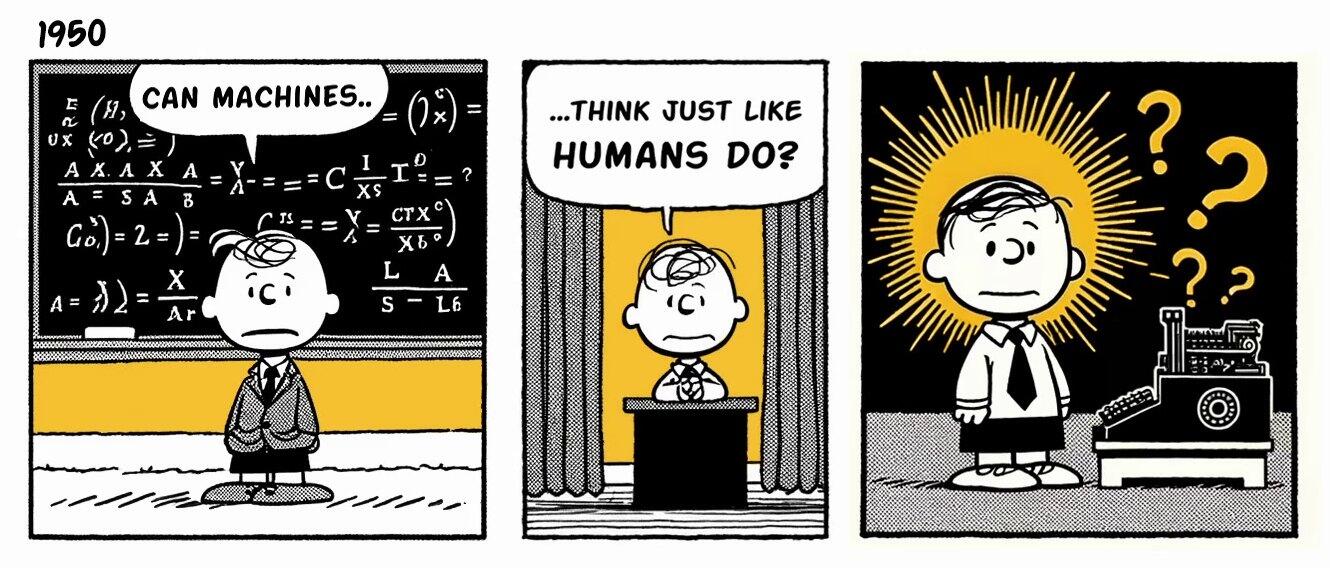
Is artificial intelligence stupid or smart?
This question shows how much we anthropomorphize AI – we attribute human characteristics to it. The answer depends on how we define "wisdom" and "stupidity". AI is exceptionally competent at narrow, specialized tasks, but it can seem surprisingly "stupid" in situations that are obvious to humans. For example, an AI system can instantly analyze thousands of architectural visualizations and suggest optimal color schemes, yet at the same time it may fail to understand a simple joke or cultural context. Artificial intelligence works based on training data – if certain information is missing from its knowledge base, it may generate incorrect or bizarre responses. Want to better understand how AI works? Read our guide – How does artificial intelligence (AI) work?AI models are extremely "smart" when it comes to:
- Processing and analyzing vast datasets
- Recognizing complex patterns
- Generating textual, graphic, or audio content
- Automating repetitive tasks
But they are "stupid" when it comes to:
- Understanding social and cultural context
- Logical reasoning in unusual situations
- Acknowledging their own limitations
- Creativity in the true sense of the word
It's worth remembering that AI is a specialized tool – it excels at the tasks it was designed for, but can fail in situations requiring flexible thinking and contextual understanding. That is why we achieve the best results by combining AI's strengths with human judgment and creativity.


CHECK OUT THE AI COURSE from the basics – discover the essential tools
Does artificial intelligence lie or tell the truth?
Here we come to one of the most interesting and controversial aspects of AI. Artificial intelligence does not lie in the sense of intentionally misleading someone – because that would require intention, and AI has no intentions. However, it can generate false information, which we call 'AI hallucinations'. AI hallucinations are situations where the system generates content that sounds convincing but is actually untrue. It could be a fabricated historical date, a non-existent scientific source, or incorrect calculations. This happens because AI does not 'know' anything in the human sense – it simply predicts the most likely continuation of text based on its training data. Does this mean that AI is lying? No, because lying requires a conscious decision to mislead someone. AI does not have such consciousness. Instead, it generates responses based on statistical probabilities, which sometimes lead to erroneous conclusions. That is why it is always advisable to verify information obtained from AI, especially when it concerns specific facts, dates, or numbers. If you want to learn how to communicate effectively with AI and minimize the risk of hallucinations, check out our guide – 10 rules for writing effective prompts – how to talk to AI so it understands you?
Can AI become conscious in the future?
This question has fascinated scientists, philosophers, and technologists for decades. Currently there is no clear answer. Some researchers believe that technological advances could lead to the emergence of artificial general intelligence (AGI – Artificial General Intelligence), which would approach or even surpass human cognitive abilities. However, even if we achieve AGI, it does not necessarily mean it will be conscious. Consciousness is one of the greatest mysteries of science – we still do not fully understand how it arises in humans, so it is hard to predict whether it can be 'created' in machines. Current AI systems, even the most advanced ones, are far from any form of consciousness. They are tools that excellently support us in daily tasks – from generating complex visualizations to practical assistance in creative work – but they remain tools, not conscious beings.
How to recognize the limitations of artificial intelligence?
Understanding the limitations of AI is crucial for effective and responsible use of these tools. Here are the main limitations of contemporary artificial intelligence: Lack of contextual understanding – AI does not truly understand the meaning of words and concepts. It analyzes statistical associations between them, which sometimes leads to absurd conclusions in atypical situations. Dependence on training data – If AI was trained on incomplete or biased data, its responses will reflect those limitations. You may want to learn more about this aspect, so we recommend the article – Is artificial intelligence safe? Facts vs myths about AI. Inability to learn in real time – Most AI models have a fixed cutoff date for training data. They do not update themselves with current events (unless specifically designed to do so). Lack of true creativity – AI can generate something that appears creative, but it is always a remix and recombination of existing patterns. It does not create anything truly new in the way a human artist does. By understanding these limitations, we can better use AI as a powerful supporting tool, rather than treating it as an infallible authority.View online courses dedicated to artificial intelligence
A practical approach to working with AI – without myths and ambiguities
Instead of wondering whether AI is conscious, smart, or stupid, it is better to focus on how to use it effectively. AI is a tool – exceptionally powerful, but still a tool. Just as a hammer has no consciousness yet perfectly serves its function in the hands of an experienced craftsman, AI works best when properly utilized by a competent user. In interior design, architecture, or computer graphics, AI can significantly speed up work and open up new creative possibilities. From generating visual concepts to practical applications in everyday work, AI becomes an invaluable support. An example could be automating measurements, which we wrote about in the article – AI-driven automatic inventories – don’t struggle with a tape measure or rangefinder! However, the key is being aware of AI’s limitations and taking a responsible approach to the results it generates. Will AI become conscious in the future? Maybe yes, maybe no – this question remains open. But today we know one thing: current artificial intelligence is a fascinating technology that changes the way we work and create, even though it does not possess consciousness in the human sense of the word.Author

Przeczytaj o programie AI - Artificial Intelligence na naszym blogu
-
![Virtual staging and AI photos in real estate listings - what does the AI Act change?]()
Virtual staging and AI photos in real estate listings - what does the AI Act change?
The AI Act vs real estate. Does virtual staging require an AI label? Find out how to avoid legal pitfalls and properly label photos. -
![How to Label AI Content According to the Law? Ready-Made Formulas for Designers and Archviz Studios.]()
How to Label AI Content According to the Law? Ready-Made Formulas for Designers and Archviz Studios.
How to Legally Label AI Visualizations? Check When a Label Is Mandatory and Copy Ready-Made Formulas for Your Projects. -
![Do you have to label visualizations as AI? What does the AI Act really say and what changes on August 2, 2026?]()
Do you have to label visualizations as AI? What does the AI Act really say and what changes on August 2, 2026?
AI Act from August 2! Do you have to label 3D visualizations as AI? Check where the legal boundary lies between concept and deepfake. -
![AI for furniture manufacturers - See how to create furniture packshots and catalog arrangements with raya.design]()
AI for furniture manufacturers - See how to create furniture packshots and catalog arrangements with raya.design
Packshots without time-consuming sessions? Discover Raya Design. Change upholstery and create arrangements with AI in moments. See how it works!