EN
EN PL
PL ES
ES


Publication date: 30-12-2025 | Update date: 30-12-2025 | Author: Mateusz Ciećwierz

-
Online courses
- All
 3ds Max
 AI - Artificial Intelligence
 Blender
 Corona renderer
 GstarCAD
 LayOut
 Photoshop
 Interior Design
 Revit
Revit Sketchup
 Stable Diffusion
 V-ray
V-ray
"Online courses" are comprehensive online training programs that will help you quickly master the software you are interested in.
- Plugins
- 3D Models
- Help
- Articles
GPT Image 1.5 vs Nano Banana Pro - comparison of AI image generators in 12 tests
AI image generators are evolving at a breakneck pace. In December 2025, OpenAI unveiled GPT Image 1.5, which was intended as a response to the dominance of Google’s Nano Banana Pro. We conducted a thorough comparison of both tools across 12 different tasks with identical prompts. We check whether the new model from the creators of ChatGPT can compete with the tool that has been receiving enthusiastic reviews for months.

Index
Nano Banana Pro is Google’s flagship model built on Gemini 3 Pro, introduced on November 20, 2025. The tool quickly gained recognition for its exceptional photorealistic image quality, precise text rendering, and editing capabilities with full scene control. Learn more about this tool in our article: Nano Banana – free AI photo editor from Google. For a long time, GPT Image from OpenAI clearly lagged behind Nano Banana Pro in many key aspects. Let’s check whether the latest 1.5 version can finally match Google’s model.


Test 1: Poster with multiple texts
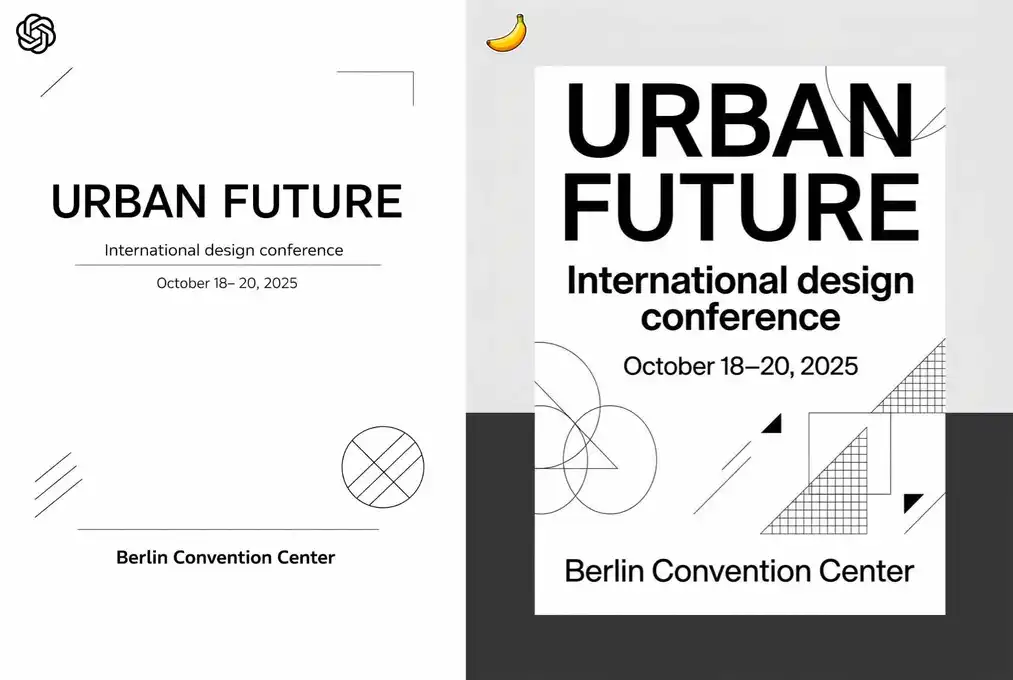
First, we prepared a poster with various texts to see if both models would include all information and maintain typographic consistency.Prompt: "Create a clean, modern event poster. Large title at the top: URBAN FUTURE. Below, smaller text: International design conference. Even lower: October 18–20, 2025. At the bottom: Berlin Convention Center. Minimalist layout, white background, black text, subtle geometric accents. Text must be legible and spelled correctly. Aspect ratio 4:5, vertical."
Both GPT and Nano Banana Pro designed consistent minimalist posters with all required information. The fonts are clear and there are no typos. Unfortunately, GPT has had issues from the start with maintaining the requested 4:5 aspect ratio – instead of a vertical graphic we received an image in different dimensions. This issue will repeat in subsequent tests.
Test 2: Infographic as a table
The second test is a simple table presenting subscription plan pricing.Prompt: "Create a flat design infographic with a comparison table. The table has 3 columns: Plan, Storage, Price and 4 rows: Free | 5 GB | $0, Basic | 50 GB | $5, Pro | 200 GB | $15, Enterprise | Unlimited | $50. Clean grid layout, light background, legible typography. Text must be perfectly readable and aligned. Aspect ratio 4:5, vertical."
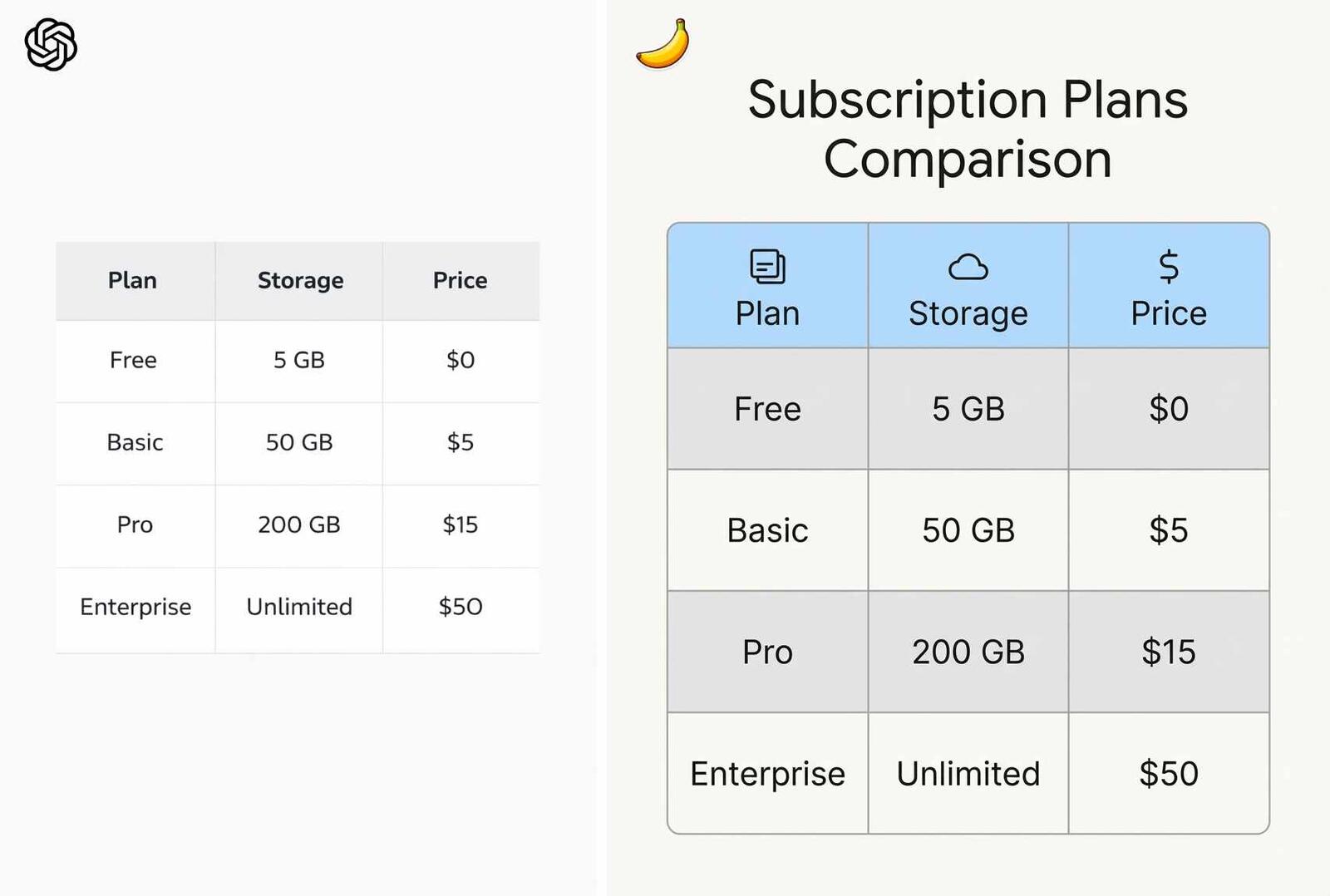
Both models handled the task well, generating readable tables with correct data. However, GPT again did not maintain the requested 4:5 aspect ratio, while Nano Banana Pro delivered the graphic exactly in the specified format. Google’s table also looks more visually refined, with icons and better use of colors.
Test 3: Spatial relationships between objects
In the third test, we checked how the models handle specific guidelines for object placement.Prompt: "Create a scene on a table with exactly seven items: a book in the center, glasses on the book, a phone to the right of the book, a mug to the left, a key in front of the book, a coin behind the book, and a pen partially covering the coin. The relationships between the objects must be exactly as described. Aspect ratio 3:2, horizontal."
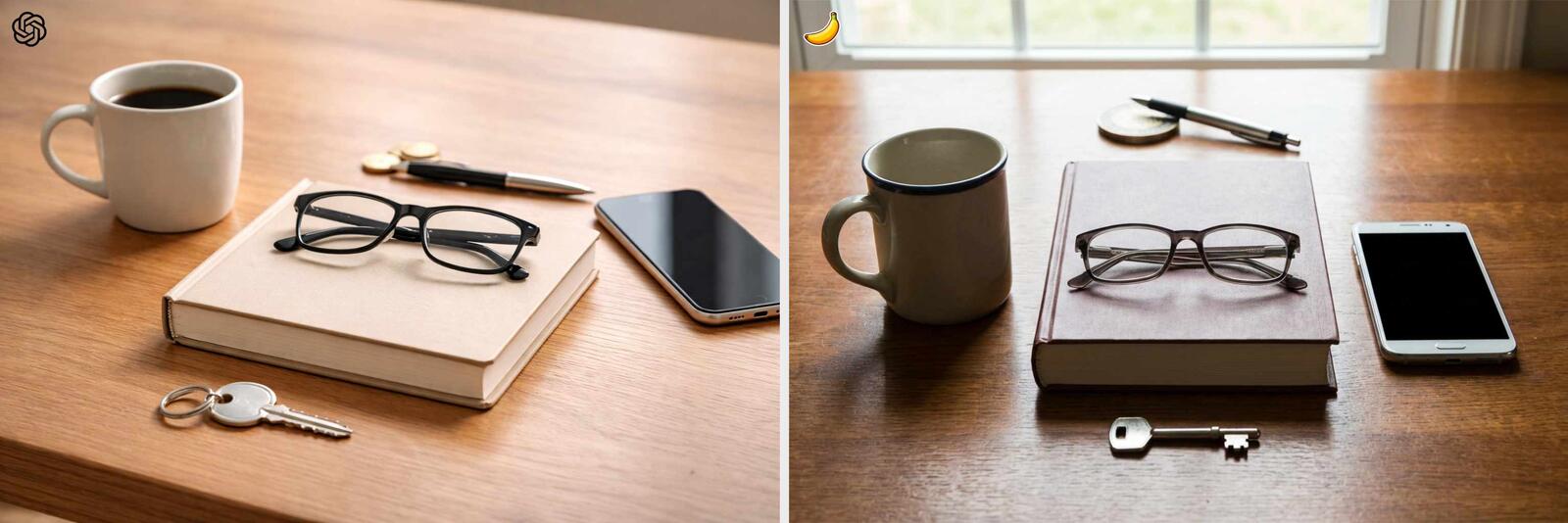
In both cases, the objects are placed correctly according to the instructions. However, the result from Nano Banana Pro looks decidedly more natural, realistic, and detailed. The GPT image unfortunately looks more like a typical AI-generated picture – too smooth, with plastic textures and artificial lighting.
Test 4: Portrait of a woman
The next task is to generate a realistic portrait of a woman in natural daylight.Prompt: "Create a realistic portrait of a woman in natural daylight. About 35 years old, brown eyes, light freckles, shoulder-length wavy hair. She wears thin round glasses and a simple black T-shirt. Neutral background, soft side lighting. Aspect ratio 1:1, square."
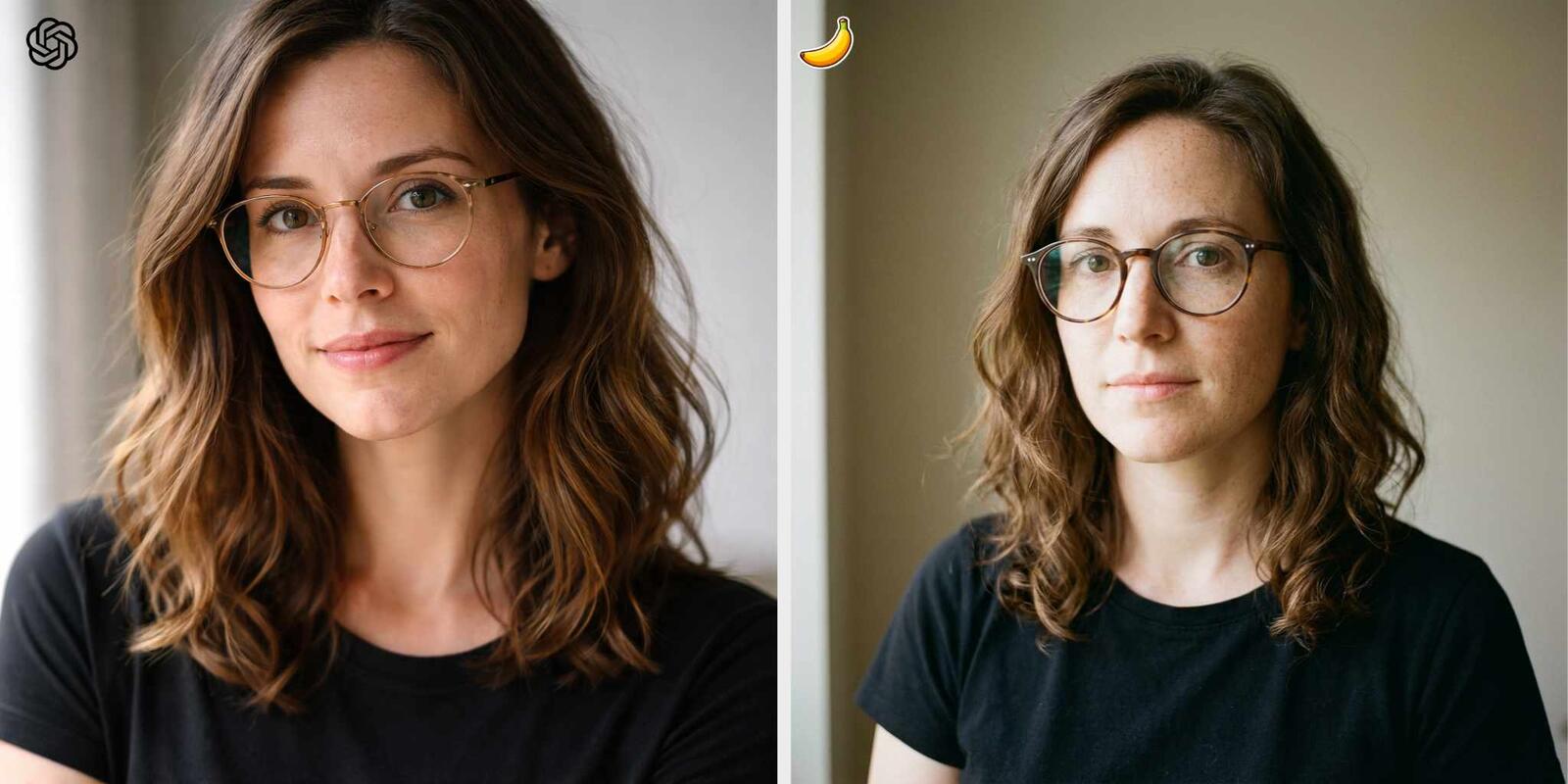
Both generated images look good, but the image from Nano Banana Pro looks decidedly more natural. Most people wouldn’t be able to tell if it’s AI or a real photo. The woman generated by GPT looks attractive but too perfect – like a magazine cover model. If I specifically asked for a model, that effect would be desired. However, Nano Banana Pro immediately provides much better and more natural results when generating ordinary people.
CHECK THE COURSE – AI VISUALIZATION IN ARCHITECTURE AND DESIGN
Test 5: Puzzle with a hand and a clock
The next test is a kind of benchmark for AI models, which they still struggle with today.Prompt: "Create a square graphic showing a hand with SIX fingers, a wine glass filled to the brim with red wine, and a wall clock showing 3:17. Arrange these elements into a coherent composition."
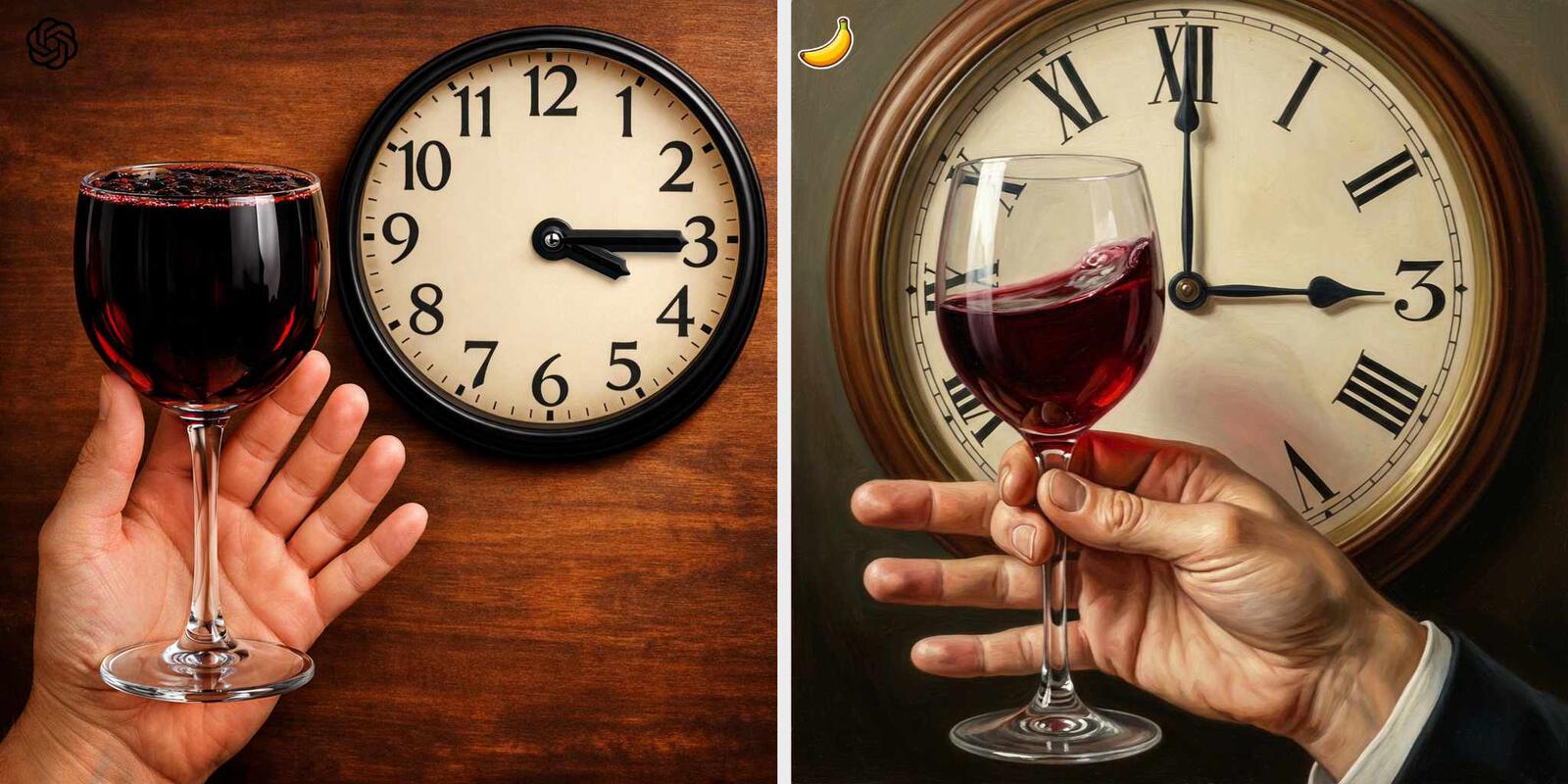
In this matchup, we can say that GPT won. On three requests it managed to fulfill two – it generated a six-fingered hand and a full wine glass. The clock unfortunately displays the wrong time. Nano Banana Pro’s image looks like an interesting painterly artwork, but it managed to satisfy only one out of three requests – the hand has six fingers. The wine glass is not full, and although the clock shows 3 o’clock, the minutes are not shown correctly.
Test 6: Character consistency across different frames
The next task is to generate 4 images of the same character in different settings while maintaining their identity.Prompt: "Aspect ratio 16:9, horizontal. Create four images of the same person. A man with short black hair, a short beard, and rectangular glasses. Scene 1: in an office. Scene 2: on a city street at night. Scene 3: in a gym. Scene 4: on a couch at home. He must clearly look like the same person in all scenes."
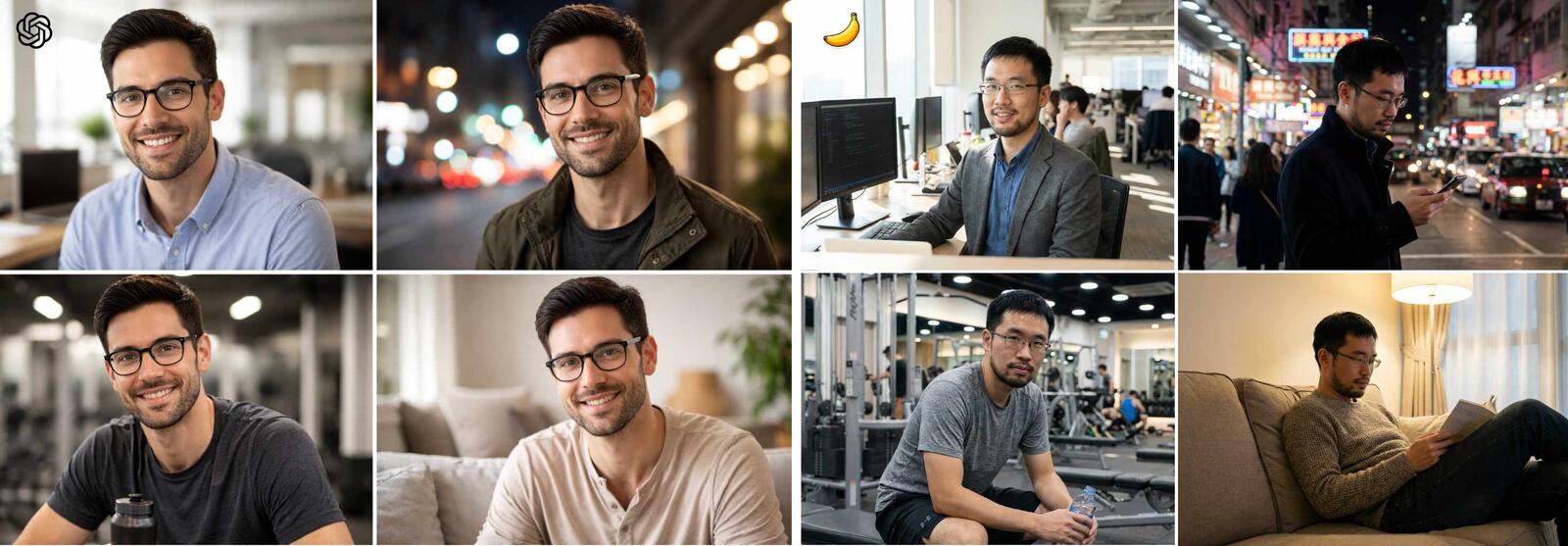
First, it’s worth noting that GPT generated 4 characters on a single graphic, while Nano Banana Pro generated 4 separate images – which in many cases may be more desirable for further editing. As for the result, in this test GPT completely failed compared to Nano Banana Pro. Similar to the portrait of the woman, the generated man looks like a typical early AI model – too perfect, with plastic skin and the same smile in every scene. The man generated by Nano Banana Pro looks incomparably more natural and truly seems to be the same person in different life situations.
Test 7: Different graphic styles
In this task, we wanted to create 3 images in different styles using a single prompt.Prompt: "Create the same street scene three times. Scene: a bicycle parked next to a café on a city street. Version 1: photorealistic. Version 2: watercolor painting. Version 3: vintage poster style. The composition must be the same in all versions. Aspect ratio 16:9, horizontal."


Like in the previous example, Nano Banana Pro generated 3 separate images, while GPT created them all on one image. Interestingly, GPT generated 4 images despite the request for 3, which shows problems with following instructions. As for the quality, again Nano Banana Pro is unbeatable. It did exactly what we asked – three clearly stylistically different versions of the same scene. GPT Image 1.5, however, produced a collage of 4 similar images that do not match our precise request for specific styles.
Test 8: Removing objects from a scene
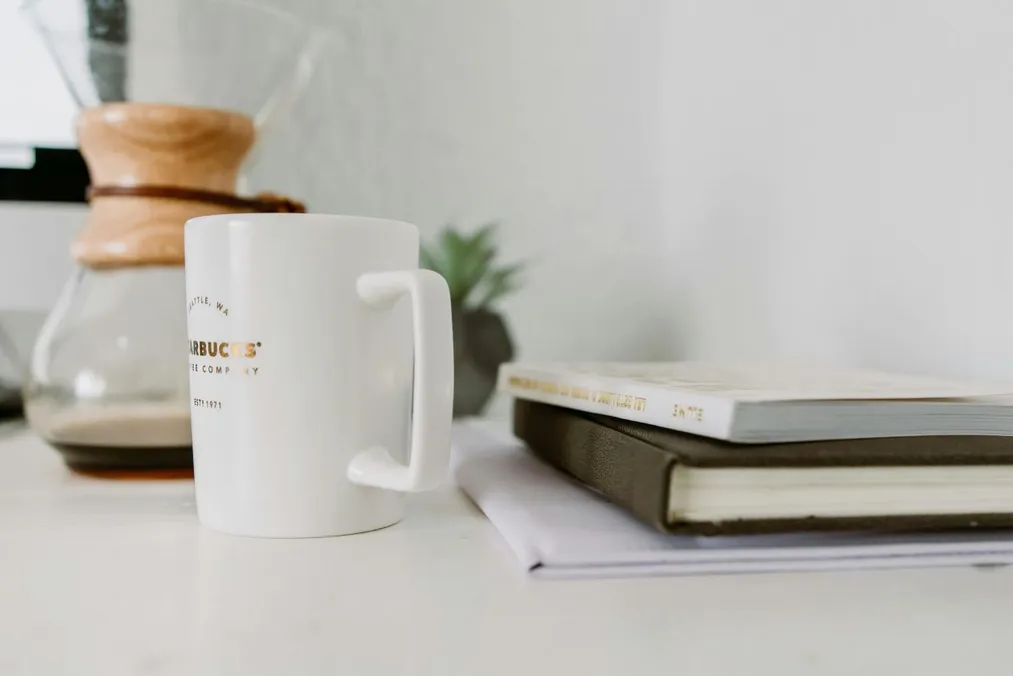
The next test is a typical AI task – removing a specific object from a scene.Prompt: "Use the same proportions as the original image. Remove the coffee mug from the image. Fill the background naturally so it looks like the mug was never there. Do not change anything else."
GPT Image 1.5
Nano Banana Pro
At first glance, both models handled it equally well – the mug is gone and the background looks natural. However, a closer look reveals a fundamental difference. GPT once again regenerated almost the entire scene. Nano Banana Pro did exactly what we asked – removed the mug but preserved 100% of the original scene without modifying any other elements. In the official OpenAI documentation we saw examples where GPT Image 1.5 does not modify the entire image, but in our tests the whole original scene was always edited.
Test 9: Changing the material of an object
The next test is also a typical AI task – changing the material of an object in a scene.Prompt: "Use the same proportions as the original image. Change the wooden table to white marble."
"Maintain the same shape, lighting, camera angle, and all objects exactly the same."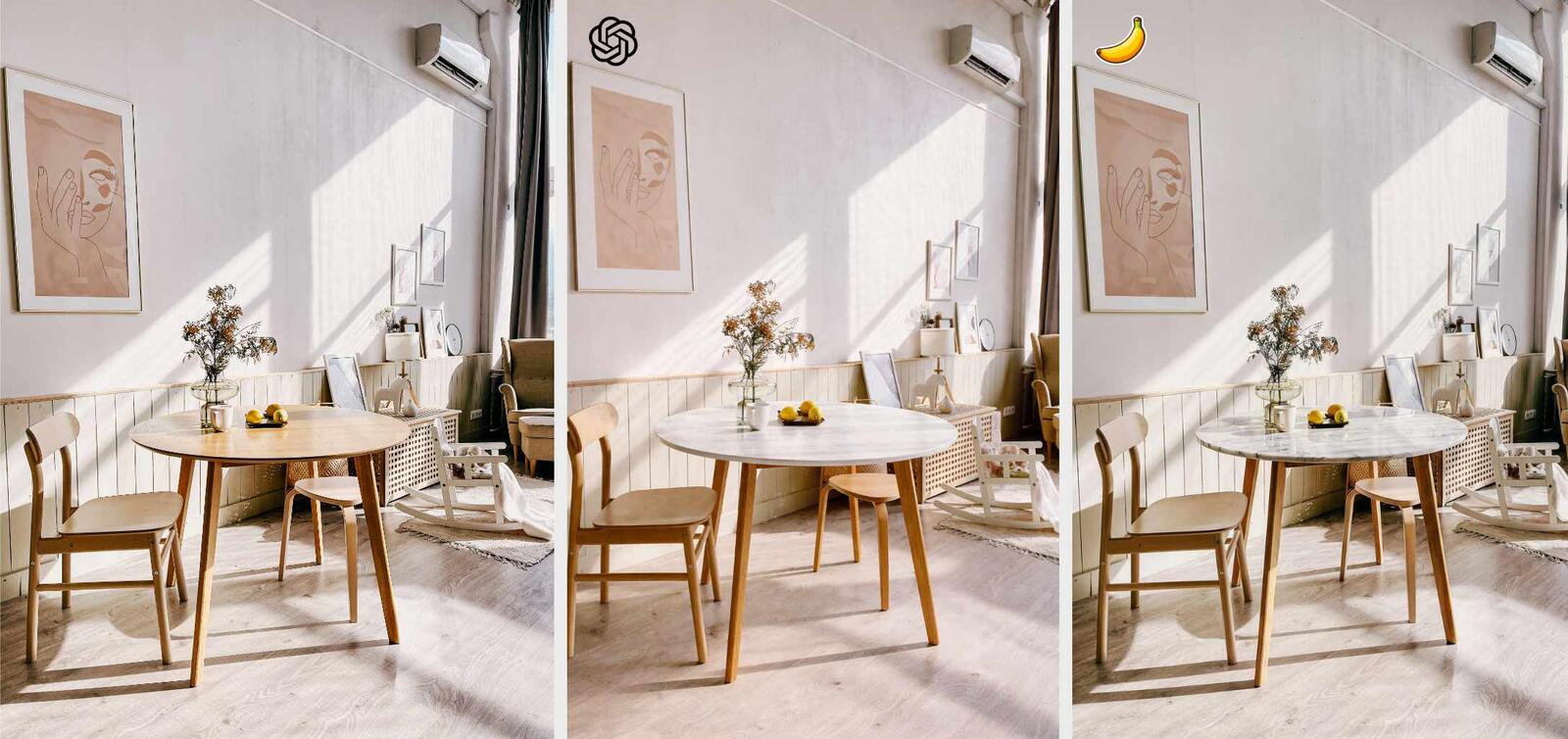
Even without a detailed comparison, it is clear that once again the entire scene was altered by GPT. Obviously it looks very similar at first glance, but our instruction not to change anything else was not followed - the chairs look different, the atmosphere of the interior has changed, and the background details are different. Nano Banana Pro once again executed the task perfectly and changed only the table to marble, preserving 100% of the original scene.
Test 10: Change of lighting
For this test we used the previously generated portrait of a woman from Nano Banana Pro.Prompt: "Use the same proportions as the original image. Change the lighting to studio lighting with strong back rim light and soft key light from the left side. Do not change objects, camera, or composition."

Unfortunately we have the same problem as before. Even though our request to change the lighting was executed correctly, the image itself was altered and the woman's facial features changed. GPT clearly shifted her character toward typical AI-generated figures - the skin became smoother, and the features more idealized. Nano Banana Pro again executed the task perfectly - it changed only the lighting, preserving the identical facial features and character of the portrait.
Test 11: Complex mechanism
The next test was completely different from the previous ones. We tried to generate a bicycle drivetrain with sprockets, chain, and derailleurs.Prompt: "Proportions 3:2, horizontal. Create a highly detailed, photorealistic close-up of a road bike drivetrain. The image must show: rear cassette, chain, rear derailleur, crankset, and front chainrings. The chain must be on the RIGHT side of the bike. The derailleur must be correctly positioned relative to the cassette. The chain must wrap correctly around the sprockets. Perspective slightly from the rear-right side. Lighting realistic like a product photo. No brand names, no logos, no text. No motion blur. Everything must be mechanically accurate."
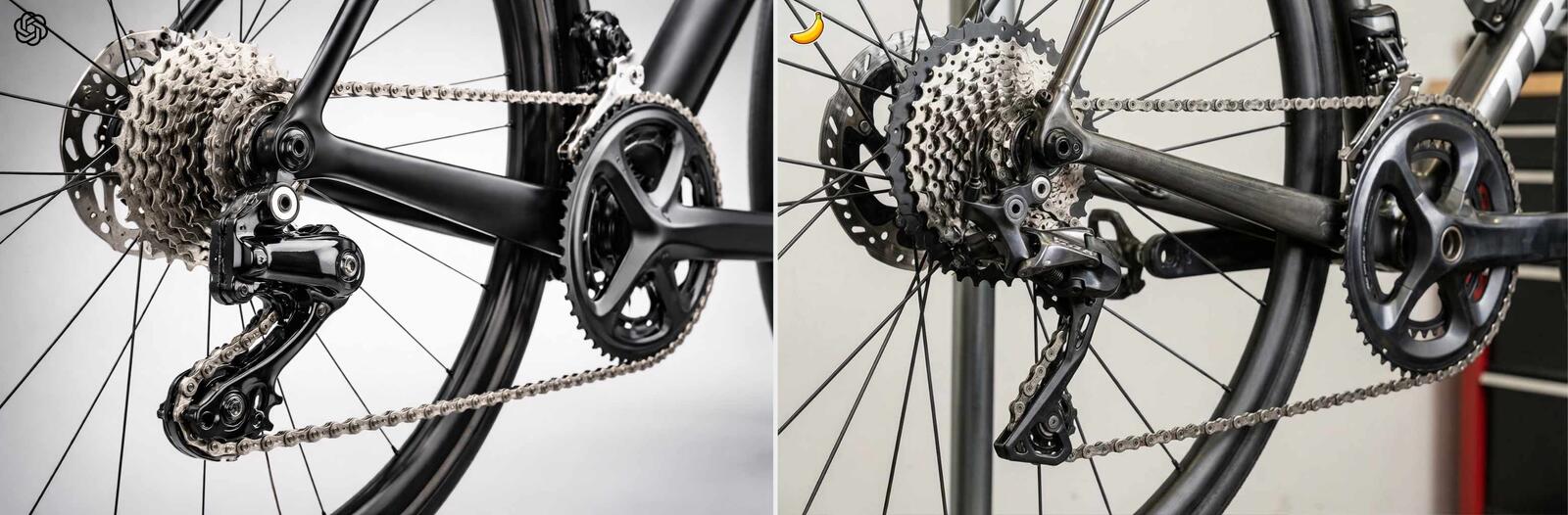
In this case both models did not perform perfectly, but Nano Banana Pro definitely generated a more realistic and natural result. Imperfections can be seen in both examples, but the bike in GPT looks more plastic-like, with various simplifications, and in my view even the bike wheel is not perfectly round. Google wins again.
Test 12: Generation with exclusions
At the end we generated a living room with several strict exclusions.Prompt: "Create a modern, photorealistic living room interior. The scene must include: a sofa, a coffee table, a bookshelf, a large window with daylight. STRICT RULES - these elements MUST NOT appear anywhere in the image: people, posters, books, flowers, objects on the table, floor lamps. The room should look realistic and be well-lit. Proportions 3:2, horizontal."
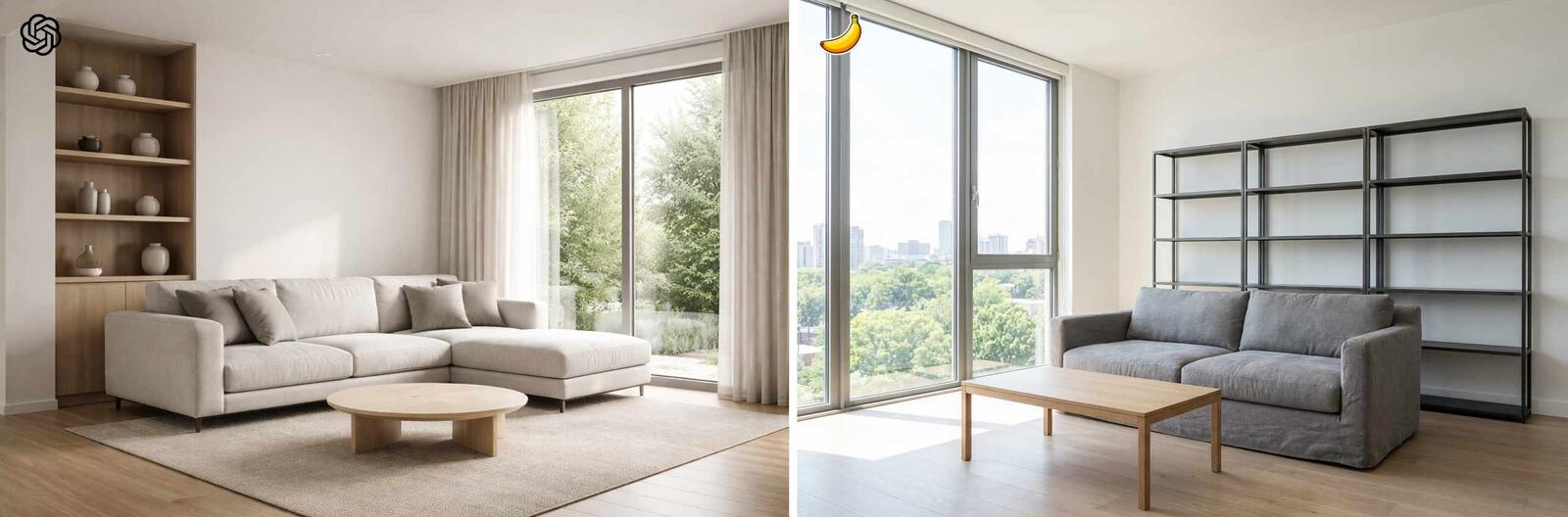
Both models handled our guidelines well - all the required elements are present, and none of the prohibited ones appeared in the scene. The only remark we have is that the illustration generated by GPT looks more like a realistic render, whereas Nano Banana Pro created an image more resembling an actual photograph of an interior.
Summary
Although the difference between GPT Image 1.5 and GPT Image 1.0 is enormous and the new model is undoubtedly a step forward for OpenAI, in many key tasks Nano Banana Pro from Google performs significantly better. Google's advantages are particularly visible in the area of portrait photorealism - people generated by Nano Banana Pro look natural, while GPT produces overly idealized figures.Another key difference is precise editing while preserving the original scene - GPT tends to reprocess entire images even for simple changes, which can be problematic in professional workflows. Nano Banana Pro also copes better with following complex instructions regarding styles, formats, and proportions. GPT Image 1.5 won only one test - with the hand, glass, and clock - where it fulfilled more detailed requirements than its competitor. The OpenAI model, however, has clear problems with maintaining the requested image proportions and the characteristic artificial look of generated people. If you want to discover the capabilities of both tools and learn how to use them in your work, on our website you will find a wide selection of courses dedicated to artificial intelligence.
Author

Przeczytaj o programie AI - Artificial Intelligence na naszym blogu
-
![Virtual staging and AI photos in real estate listings - what does the AI Act change?]()
Virtual staging and AI photos in real estate listings - what does the AI Act change?
The AI Act vs real estate. Does virtual staging require an AI label? Find out how to avoid legal pitfalls and properly label photos. -
![How to Label AI Content According to the Law? Ready-Made Formulas for Designers and Archviz Studios.]()
How to Label AI Content According to the Law? Ready-Made Formulas for Designers and Archviz Studios.
How to Legally Label AI Visualizations? Check When a Label Is Mandatory and Copy Ready-Made Formulas for Your Projects. -
![Do you have to label visualizations as AI? What does the AI Act really say and what changes on August 2, 2026?]()
Do you have to label visualizations as AI? What does the AI Act really say and what changes on August 2, 2026?
AI Act from August 2! Do you have to label 3D visualizations as AI? Check where the legal boundary lies between concept and deepfake. -
![AI for furniture manufacturers - See how to create furniture packshots and catalog arrangements with raya.design]()
AI for furniture manufacturers - See how to create furniture packshots and catalog arrangements with raya.design
Packshots without time-consuming sessions? Discover Raya Design. Change upholstery and create arrangements with AI in moments. See how it works!