EN
EN PL
PL ES
ES


Publication date: 27-11-2025 | Update date: 26-11-2025 | Author: Piotr Kurpiewski

-
Online courses
- All
 3ds Max
 AI - Artificial Intelligence
 Blender
 Corona renderer
 GstarCAD
 LayOut
 Photoshop
 Interior Design
 Revit
Revit Sketchup
 Stable Diffusion
 V-ray
V-ray
"Online courses" are comprehensive online training programs that will help you quickly master the software you are interested in.
- Plugins
- 3D Models
- Help
- Articles
Artificial intelligence - AI - for furniture manufacturers - see what possibilities it offers!
Artificial intelligence in the furniture industry now allows generating photorealistic packshots, product visualizations, and interior arrangements without photoshoots or advanced graphic expertise. AI changes fabrics, colors, and wood finishes, can create product variants from a single material sample, and faithfully reproduces construction details of furniture. Based on a simple model or photo, it’s possible to create complete marketing communications: from packshots and lifestyle scenes to catalog materials. This article shows practical examples of applications and benefits that AI is already bringing to furniture manufacturers and marketing departments.

Index
How to use AI in the furniture industry? Practical applications that work today
Artificial intelligence in furniture manufacturing is not a futuristic vision but a real tool that can replace costly photo shoots, lengthy 3D visualization processes, and multi-stage prototyping. It also does not require technical experience or complex rendering knowledge. All you need is a basic model of the product, a sketch, or a reference photo. Based on that, AI generates full-fledged packshots, interior arrangements, various color variants, and marketing materials ready to use in social media, catalogs, and online stores.
Photorealistic furniture packshots - no rendering, no photo sessions, no studio
A traditional product shoot involves logistics, furniture transport, studio rental, lighting, a photographer, and a lengthy post-production process. An alternative is 3D studios that handle photorealistic visualizations. AI reduces this entire process to a single step.
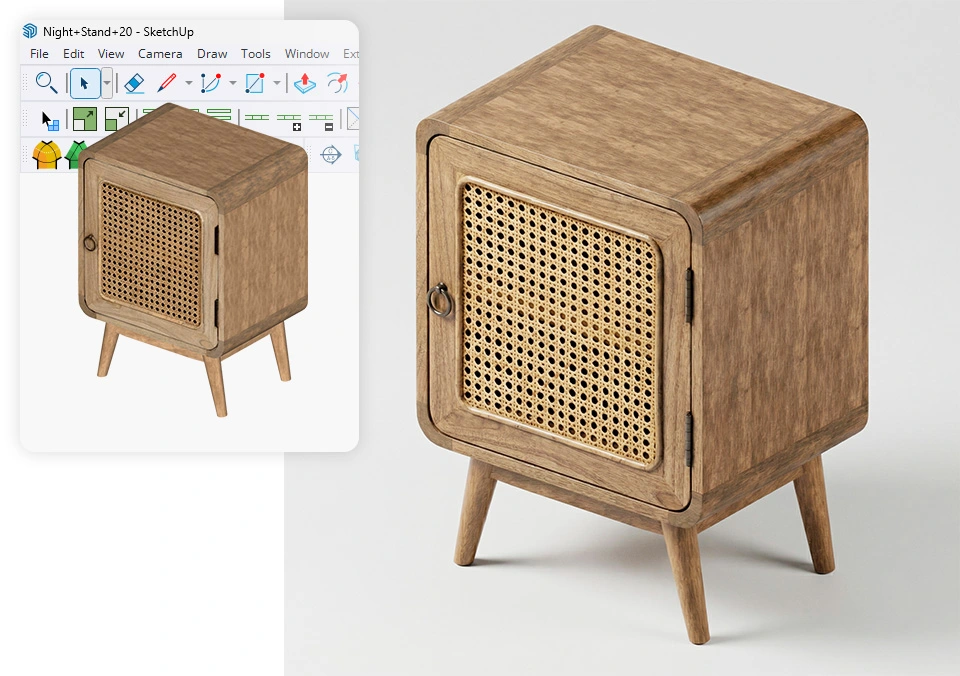
All you need is a simple model in SketchUp or another software. Let’s take this wooden nightstand as an example. The algorithm can analyze its construction and reproduce the details with a quality that previously required rendering or professional photography. In the end, it creates a realistic packshot that can be modified, refined, and cloned at will.
This solution is especially attractive for manufacturers who want to showcase new models faster than physical prototype production allows. Artificial intelligence enables pre-production sales: first we gauge interest, then we put the furniture into production. It’s a real saving of time and money!
Changing the color, fabric, and finish of furniture with one click
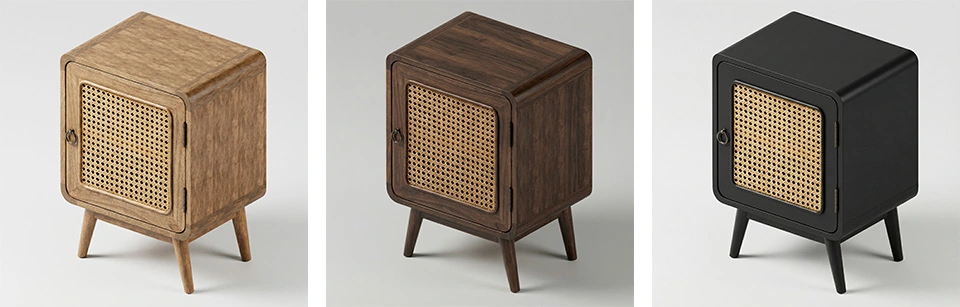
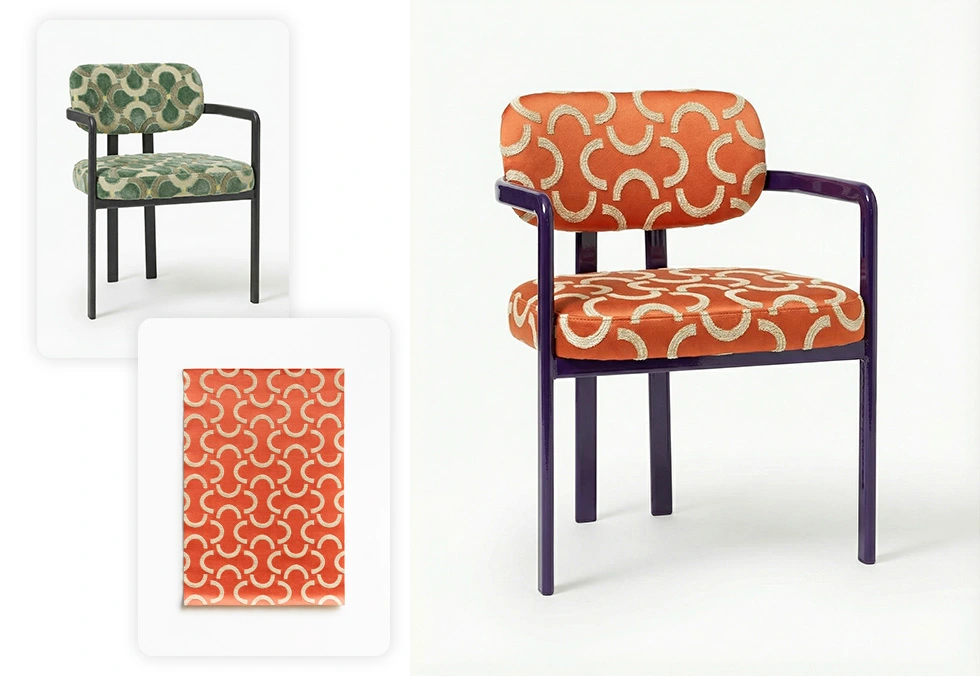
AI allows you to generate a complete product line without photographing each variant. You can upload a fabric swatch or a wood photo, and the model will apply them to the seat, backrest, frame, or front of the furniture, preserving dye, lighting, texture, and grain direction.
Look at the examples of a chair with uniform upholstery. The change happens based on just two images and a simple text instruction – no additional rendering, no new 3D model.
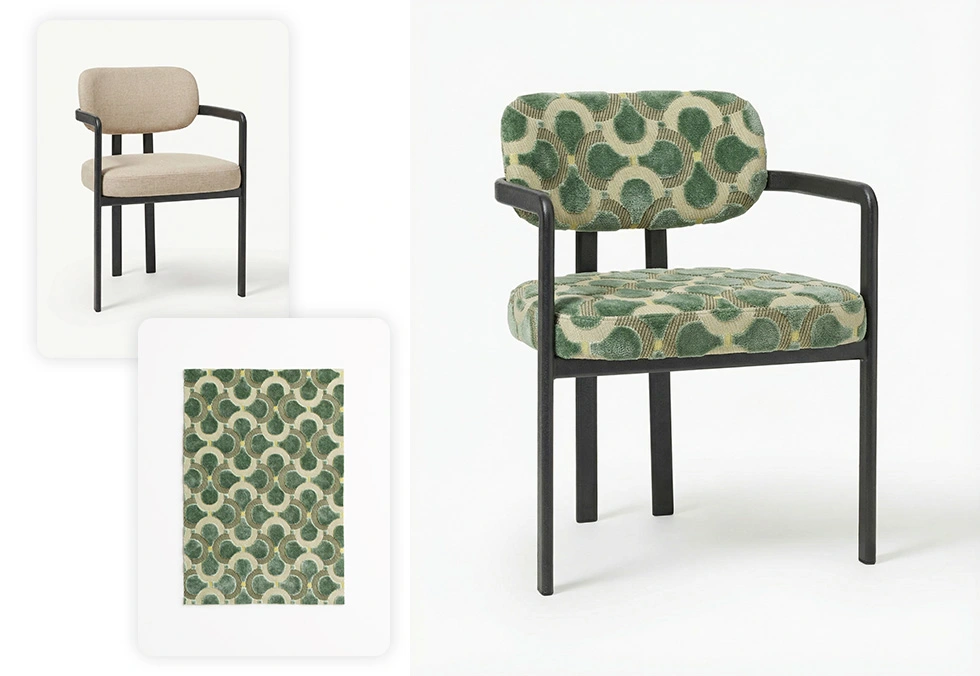
Modern multimodal models maintain full consistency and repeatability, even after multiple revisions.
This is especially valuable for marketing departments. Preparing a catalog of color variants takes minutes, not weeks. Simply change the material swatch: AI understands by itself where it should appear and how to reproduce lighting conditions on the fabric structure. As a result, customers are presented with dozens of options without physical sewing, painting, or manufacturing parts.
Interior designs with products generated in minutes
The biggest advantage of AI over classic rendering is the speed of creating visualizations. You just upload a model of a chair or cabinet and specify the interior style: modern, Scandinavian, mid-century, or Japandi. The algorithm builds the entire room with lighting, textures, and proportions and then seamlessly integrates the furniture into it. Importantly, it can replicate material context, so wood looks like wood, and upholstery does not appear as a flat print. They have truly photorealistic qualities.
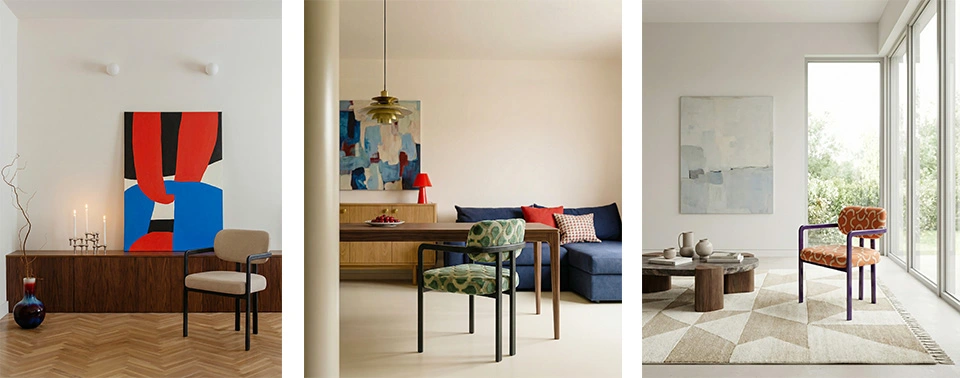
The examples above show how the same chair model works in different stylistic themes. One composition is neutral, evoking the calm of mid-century design. The second, with a green pattern, is kept in a contemporary Memphis spirit. The third – the boldest – features elements of orange and purple. Artificial intelligence today understands proportions, perspective, and lighting, making the product look as it would in reality.
Realistic prototype visualizations even before they hit the market
For furniture manufacturers, this function is particularly important. A sketch or a simplified model is enough. AI can fill in missing details, smooth edges, correct proportions, and generate the final render (but without a rendering program!). In the example of the nightstand, you can see how a model with flat lighting and indistinct texture becomes a realistic packshot with believable wood and a woven front.
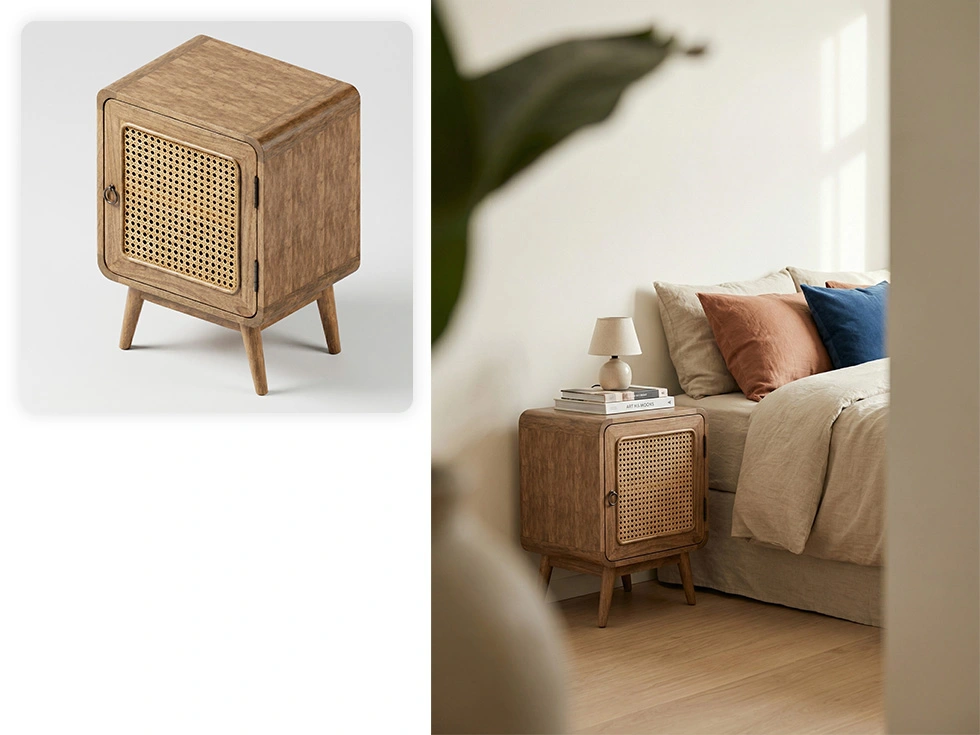
This paves the way for rapid project validation. You can prepare a sales brochure even before the carpentry stage, gather orders, and only then proceed to production. The company does not risk excess inventory because sales precede the physical manufacturing of the furniture.
AI in furniture marketing: an advantage you can implement immediately
You don’t need expensive hardware or a graphic department. Most services run in the cloud, so the computations are performed on the tool provider’s servers. In practice, this means that a single marketing employee can create materials at the level of a large rendering department:
- packshots,
- visualizations,
- catalog photos,
- lifestyle scenes.
This is a revolution especially for medium and small manufacturers. Until recently, professional rendering was out of their budget range. Today you can build a brand's visual identity with the same quality level as global brands but at a fraction of the cost.
What’s next? Motion, animation, and the product in use
Currently, AI models can create short animations: a 360° spin presentation of a piece of furniture, a camera flyover of upholstery detail, or a scene where a user sits on the chair.
Just a year ago, such things required specialized motion design knowledge and many hours spent in complex software. Now a simple prompt (text instruction), a first frame (e.g., generated by AI), and a few dozen seconds of free time are enough.
This is just the beginning! The next phase will enable artificial intelligence to generate full video ad spots: with studio lighting, sound, actors, and automatically created storyboards.
Want to learn this process step by step?
If you want to independently create packshots, interior visualizations, product layouts, and animations, check out our AI visualization and video course - Nano Banana, FLUX Kontext, Veo, etc. in architecture and design.
After this training, you will be able to generate marketing materials, product catalogs, and entire interior scenes on your own: with a speed that was recently unattainable.
Author

Przeczytaj o programie AI - Artificial Intelligence na naszym blogu
-
![Virtual staging and AI photos in real estate listings - what does the AI Act change?]()
Virtual staging and AI photos in real estate listings - what does the AI Act change?
The AI Act vs real estate. Does virtual staging require an AI label? Find out how to avoid legal pitfalls and properly label photos. -
![How to Label AI Content According to the Law? Ready-Made Formulas for Designers and Archviz Studios.]()
How to Label AI Content According to the Law? Ready-Made Formulas for Designers and Archviz Studios.
How to Legally Label AI Visualizations? Check When a Label Is Mandatory and Copy Ready-Made Formulas for Your Projects. -
![Do you have to label visualizations as AI? What does the AI Act really say and what changes on August 2, 2026?]()
Do you have to label visualizations as AI? What does the AI Act really say and what changes on August 2, 2026?
AI Act from August 2! Do you have to label 3D visualizations as AI? Check where the legal boundary lies between concept and deepfake. -
![AI for furniture manufacturers - See how to create furniture packshots and catalog arrangements with raya.design]()
AI for furniture manufacturers - See how to create furniture packshots and catalog arrangements with raya.design
Packshots without time-consuming sessions? Discover Raya Design. Change upholstery and create arrangements with AI in moments. See how it works!