EN
EN PL
PL ES
ES


Publication date: 26-05-2025 | Update date: 26-05-2025 | Author: Piotr Kurpiewski

-
Online courses
- All
 3ds Max
 AI - Artificial Intelligence
 Blender
 Corona renderer
 GstarCAD
 LayOut
 Photoshop
 Interior Design
 Revit
Revit Sketchup
 Stable Diffusion
 V-ray
V-ray
"Online courses" are comprehensive online training programs that will help you quickly master the software you are interested in.
- Plugins
- 3D Models
- Help
- Articles
3D Model Generation with Artificial Intelligence
Artificial intelligence is increasingly influencing the 3D model creation process, enabling the generation of three-dimensional meshes from photos using advanced algorithms and photogrammetry. Technologies such as those offered by Stability AI (TripoSR, Fast 3D models) and platforms like Lumalabs (Genie model) allow for rapid model prototyping, which is especially useful in concept art and game development. Although these tools have limitations in terms of quality and detail, they can still assist artists in the early stages. Currently, artificial intelligence supports the process but does not completely replace traditional methods, particularly in demanding projects. In the future, the advancement of this technology could greatly ease the work of designers and creators.
Index
In recent years, artificial intelligence has played an increasingly important role in the process of creating 3D models. Technologies that were previously reserved for large studios and professional artists are now available to anyone with Internet access. But how exactly does AI-driven 3D model generation work and what are its limitations? In this article, we will look at how AI is impacting the world of 3D graphics.
How Does 3D Model Creation with Artificial Intelligence Work?
Generating three-dimensional meshes is based on transforming photos using advanced AI algorithms and photogrammetry.Sometimes even a single image is enough! AI analyzes the provided images, identifies key points, and reconstructs the object's geometry based on them. This process can utilize neural networks to identify shapes and textures, as well as to predict missing information needed to create a complete model. Technologies such as generative models (GANs) and machine learning algorithms can reproduce object details even when the input data is incomplete.
New Mesh Generation Possibilities with Stability AI
One of the newest and most interesting tools for creating 3D models comes from Stability AI, the co-creators of Stable Diffusion. Zero123, TripoSR, and Fast 3D are AI models that enable free generation of three-dimensional meshes. They use advanced algorithms to create models from two-dimensional images. If you're curious how this works in practice, check out the TripoSR demo by Stability AI.
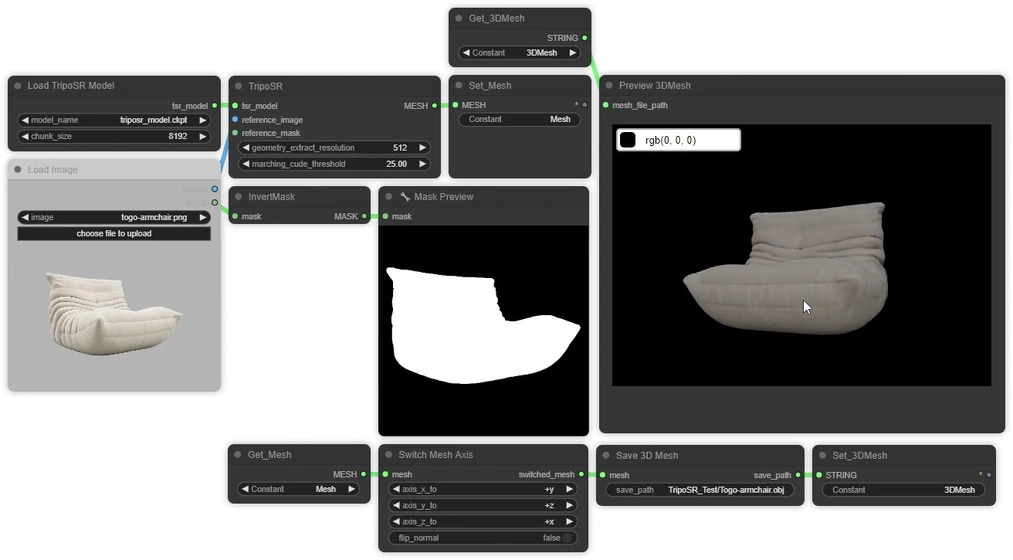
This technology is becoming especially popular among creators who want to build models without manually modeling every detail. It has huge potential in the creation of concept art and in game development. Thanks to rapid prototyping, these tools help artists visualize ideas and concepts in a short time.
Fully leveraging the capabilities of TripoSR or Fast 3D models requires some knowledge. To achieve good results, the user must understand how to operate the Stable Diffusion interface, i.e., how to choose the right parameters and how to work with input data so the AI has an appropriate basis for generating the model. In practice, this means that despite free access, you need to spend some time learning the interface and experimenting to achieve the desired effect.
In my course on the basics of Stable Diffusion, I discussed in detail how to work effectively with these kinds of tools to maximize their potential. For more details, check out the AI course – Artificial Intelligence – Stable Diffusion Basics.
Alternative Platforms for 3D Model Generation
Many platforms, such as Lumalabs (primarily known for video generation), allow you to generate 3D models directly in the browser without specialized knowledge. Lumalabs offers the Genie model, which enables model generation based on text descriptions. This makes the tool accessible to both hobbyists and professionals looking for quick results.
Genie has an easy-to-use interface that allows users to generate models in a few simple steps. Just describe what you want to achieve, and the AI takes care of the rest, converting the prompt into a 3D model. Unfortunately, this tool has some limitations in terms of model quality and detail. Generation based on descriptions often does not yield fully satisfactory results, especially for more complex objects.
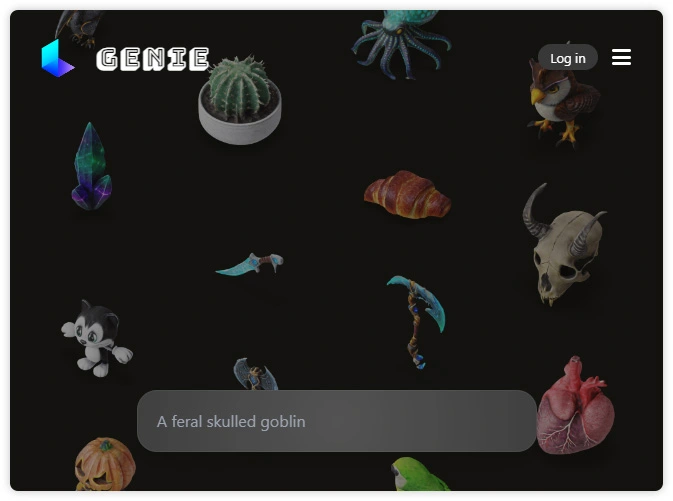
Platforms like Genie are ideal for quickly generating prototypes or models that do not require high precision. However, for those seeking more advanced results, it is necessary to use more sophisticated tools that rely more on photogrammetry than on machine learning algorithms.
CHECK OUT OUR AI – ARTIFICIAL INTELLIGENCE COURSES!
Challenges and Limitations of AI-Based 3D Model Generation
One of the main challenges in AI-based 3D model generation is creating meshes from a limited number of photos. Although the algorithms are advanced, they still struggle to reproduce intricate details when the input data is limited. The more images we provide to the AI, the better the results will be.
For more demanding projects where precision and quality are crucial, it's worth using software based on photogrammetry technology, such as RealityCapture. This technology involves processing a large number of photos to create accurate 3D models. Photogrammetry allows you to achieve realistic results, especially for complex objects like architecture, furniture, or natural elements. In this case, artificial intelligence is used during the finalization stage, where it helps optimize meshes and automatically correct errors, but it does not serve as the main model-generating component. You can read more about this in our article titled: “Photogrammetry – creating 3D meshes from photos – how does it work?”.
The Future of 3D Modeling with Artificial Intelligence
The technology for generating 3D models using AI is still in a phase of rapid development, and many changes and improvements lie ahead. In the future, we can expect more advanced algorithms that will better understand input data, allowing for the generation of even more complex and realistic models from minimal amounts of data.
Currently, despite many advantages, artificial intelligence still struggles to fully replace humans in the 3D modeling process. The quality of AI-generated models leaves much to be desired. Result stability, detail control, and realistic material rendering are elements that still require improvement. It's hard to imagine these models being used in the architectural or interior design industries at present; however, they work great in the conceptual phase.
Conclusion
3D model generation using artificial intelligence opens up many new possibilities, simplifying the creation process and allowing for faster prototyping. Tools such as Stability AI and Lumalabs help creators bring their ideas to life, although they still have limitations, particularly in terms of quality and detail. Nonetheless, this technology is evolving rapidly, and future innovations could significantly impact how designers work, especially during the conceptual phase.
If you want to better understand how to effectively use AI in 3D model generation, I invite you to my AI course – Artificial Intelligence – Stable Diffusion Basics. This course will help you maximize the potential of available tools and significantly enhance your 3D graphics skills.
Author

Przeczytaj o programie AI - Artificial Intelligence na naszym blogu
-
![Virtual staging and AI photos in real estate listings - what does the AI Act change?]()
Virtual staging and AI photos in real estate listings - what does the AI Act change?
The AI Act vs real estate. Does virtual staging require an AI label? Find out how to avoid legal pitfalls and properly label photos. -
![How to Label AI Content According to the Law? Ready-Made Formulas for Designers and Archviz Studios.]()
How to Label AI Content According to the Law? Ready-Made Formulas for Designers and Archviz Studios.
How to Legally Label AI Visualizations? Check When a Label Is Mandatory and Copy Ready-Made Formulas for Your Projects. -
![Do you have to label visualizations as AI? What does the AI Act really say and what changes on August 2, 2026?]()
Do you have to label visualizations as AI? What does the AI Act really say and what changes on August 2, 2026?
AI Act from August 2! Do you have to label 3D visualizations as AI? Check where the legal boundary lies between concept and deepfake. -
![AI for furniture manufacturers - See how to create furniture packshots and catalog arrangements with raya.design]()
AI for furniture manufacturers - See how to create furniture packshots and catalog arrangements with raya.design
Packshots without time-consuming sessions? Discover Raya Design. Change upholstery and create arrangements with AI in moments. See how it works!