EN
EN PL
PL ES
ES


Publication date: 23-05-2025 | Update date: 23-05-2025 | Author: Mateusz Ciećwierz

-
Online courses
- All
 3ds Max
 AI - Artificial Intelligence
 Blender
 Corona renderer
 GstarCAD
 LayOut
 Photoshop
 Interior Design
 Revit
Revit Sketchup
 Stable Diffusion
 V-ray
V-ray
"Online courses" are comprehensive online training programs that will help you quickly master the software you are interested in.
- Plugins
- 3D Models
- Help
- Articles
Claude 4 Now Available! The New Leader Among AI Models from Anthropic
On May 22, 2025, Anthropic, known for its innovative solutions in the field of artificial intelligence, introduced the latest AI models to the world: Claude Opus 4 and Claude Sonnet 4. These advanced models represent the next step in AI evolution, offering users even greater capabilities in coding, reasoning, and autonomous operation.
Index
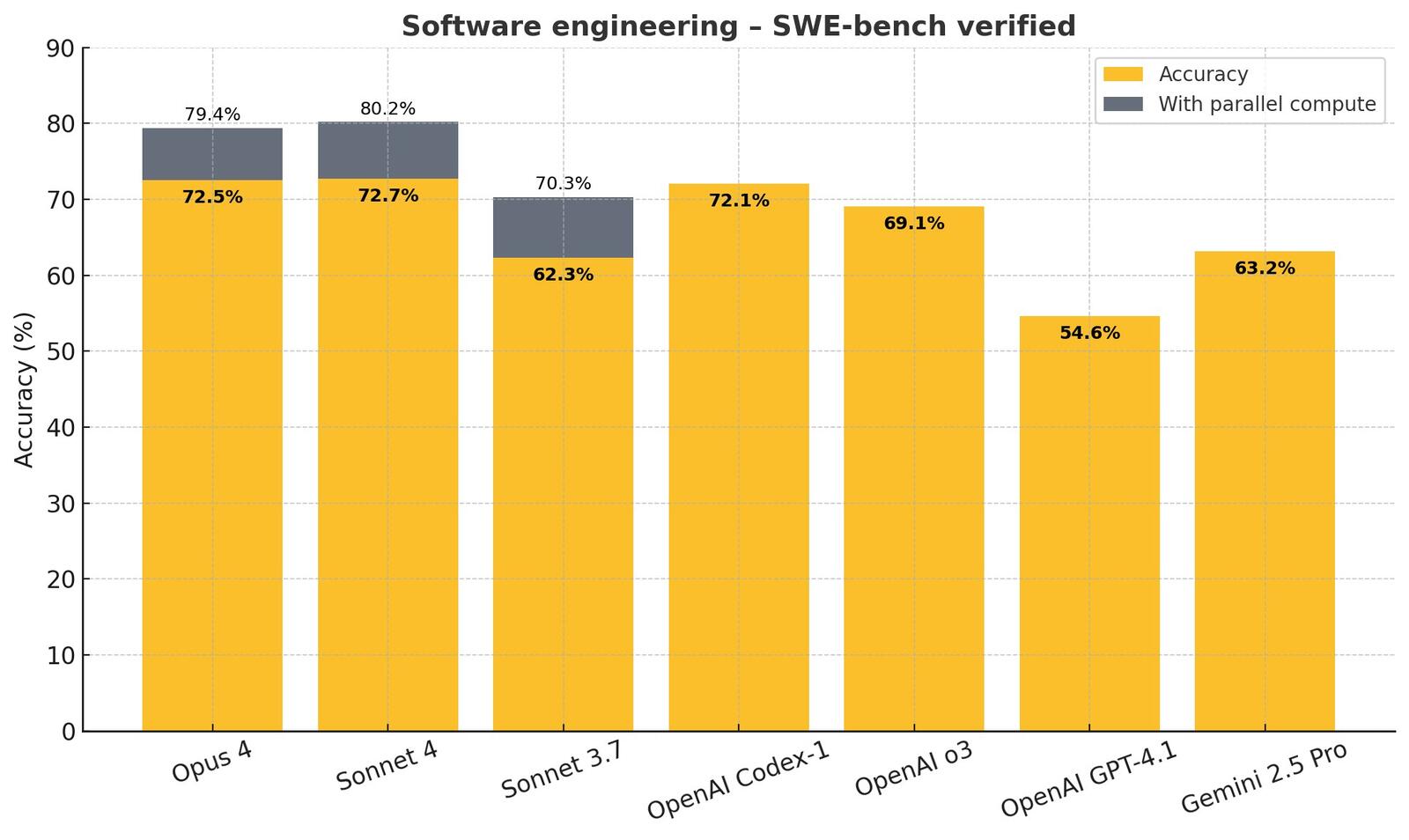
Claude Opus 4 is Anthropic’s flagship model, already recognized as one of the most powerful coding tools on the market. In benchmark tests it achieved impressive results: 72.5% on the SWE-bench test and 43.2% on the Terminal-bench, outperforming the competition in robustness and effectiveness in long-term, multi-stage agent tasks.
This model was designed for applications requiring deep reasoning, planning and adaptation – from refactoring large codebases, through research synthesis, to coordinating multi-stage processes in enterprises. Opus 4 can maintain high performance even during hours-long operations, as confirmed by tests conducted by Anthropic’s business partners.
Claude Sonnet 4 – Efficiency and precision
Sonnet 4 is a model designed for users seeking a compromise between computational power, speed and cost. It represents a significant step forward compared to the previous version (Sonnet 3.7), offering better reasoning, more precise instruction execution and higher effectiveness in coding tasks. Sonnet 4 is suitable both as a standalone agent for everyday development tasks and as a subagent in more complex multi-agent systems – e.g. for code reviews, bug fixing or API integration.
New features and capabilities
- Extended tool-assisted reasoning (beta): Models can use tools such as a web search engine during extended reasoning processes, enabling them to alternate between logic and external data sources.
- Parallel tool usage: Claude 4 can use multiple tools simultaneously, speeding up the completion of complex tasks.
- Enhanced memory: With access to local files, models can store key facts, allowing for continuity and knowledge building over longer time spans.
- Claude Code: A collaboration tool for developers, supporting integrations with GitHub Actions, VS Code, and JetBrains, enabling seamless code workflows.
- New API capabilities: Introduction of tools for code execution, integration with external systems (MCP connector), file handling, and prompt caching.
Availability and pricing
Claude Opus 4 and Sonnet 4 are already available in Anthropic services, Amazon Bedrock, and Google Cloud Vertex AI. Sonnet 4 is available to both paid and free users, while Opus 4 is available exclusively to subscribers. The pricing remains at previous model levels: Opus 4 costs 15 USD per million input tokens and 75 USD per million output tokens, while Sonnet 4 costs 3 USD and 15 USD respectively.
CHECK OUT ONLINE ARTIFICIAL INTELLIGENCE COURSES
The significance of the Claude 4 launch for the AI market
The launch of Claude 4 is not only another step in Anthropic’s development, but also a significant signal for the entire AI industry. These models set new boundaries in autonomous agent capabilities, coding, and long-term reasoning, which may accelerate the adoption of artificial intelligence in business, science, and everyday life.
Anthropic, backed by investors such as Amazon, is focusing on dynamic growth and is already planning to increase revenues to 12 billion dollars by 2027. Claude 4 is set to be a key tool in achieving these ambitious goals.
With the launch of Claude 4, Anthropic is strengthening its position as a leader in artificial intelligence by offering tools that not only meet current market needs but also set the direction for its future development.
Author

Read on our blog
-
![Profile Builder 4 or Magic Molding? Comparison of Ornamentation Plugins in SketchUp]()
Profile Builder 4 or Magic Molding? Comparison of Ornamentation Plugins in SketchUp
How does Profile Builder 4 differ from Magic Molding? Scope, pricing, profile libraries, and learning curve. Find out which plugin fits your projects. -
![The Best Free SketchUp Plugins for Interior Designers in 2026!]()
The Best Free SketchUp Plugins for Interior Designers in 2026!
Which SketchUp plugins are really worth having? Discover 7 free extensions for interior designers and find out which ones have just stopped being free! -
![English wainscoting in SketchUp - how to design wall panels step by step]()
English wainscoting in SketchUp - how to design wall panels step by step
How to design English wainscoting in SketchUp? Learn the rules for panel division, wainscot proportions, and speed up your work with the Magic Molding plugin. -
![Reversed Faces in SketchUp – why are blue faces showing and how to fix them?]()
Reversed Faces in SketchUp – why are blue faces showing and how to fix them?
Blue faces in SketchUp are flipped faces. Learn where they come from, how to quickly locate and fix them before they mess up your render or model export.