EN
EN PL
PL ES
ES


Publication date: 10-07-2025 | Update date: 10-07-2025 | Author: Piotr Kurpiewski

-
Online courses
- All
 3ds Max
 AI - Artificial Intelligence
 Blender
 Corona renderer
 GstarCAD
 LayOut
 Photoshop
 Interior Design
 Revit
Revit Sketchup
 Stable Diffusion
 V-ray
V-ray
"Online courses" are comprehensive online training programs that will help you quickly master the software you are interested in.
- Plugins
- 3D Models
- Help
- Articles
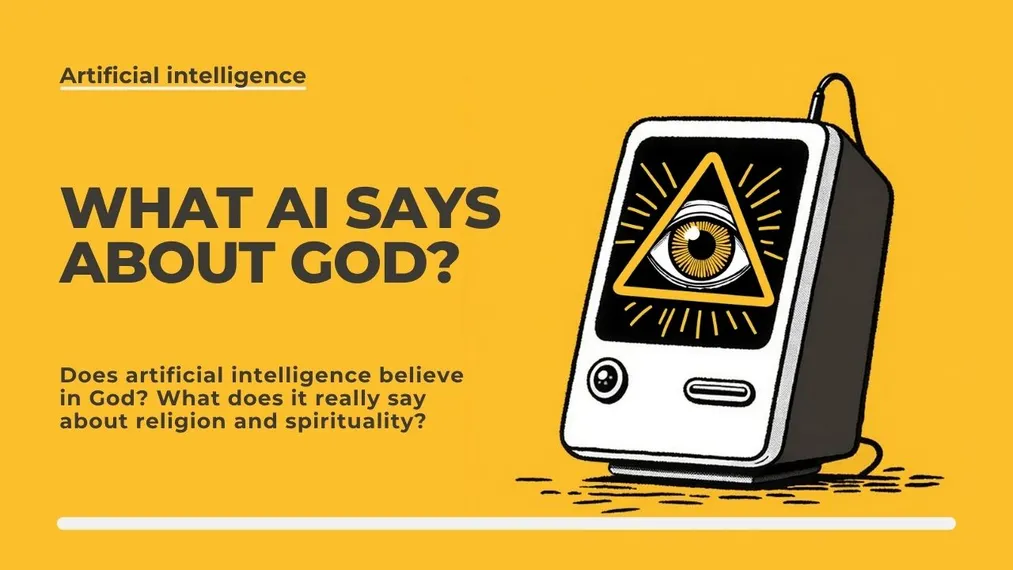
Does artificial intelligence believe in God? What does AI really say about religion and spirituality?
This article analyzes the popular question: “does artificial intelligence believe in God?”. It shows that AI's answers do not stem from belief but from mathematical language models that reconstruct human utterances. Referring to Richard Dawkins and Kazuo Ishiguro, it explains why AI cannot possess spirituality or religious convictions. The article helps to understand where AI's answers on religious topics come from and how to avoid misinterpreting them.
Index
Artificial intelligence and religion is a topic that appears more and more often in search engines. Questions like “what does artificial intelligence say about God” or “does AI believe in God” spark interest but also require a reliable explanation. Although they sound intriguing, they actually stem from misunderstandings about what modern artificial intelligence really is.
Why do we ask AI about God?
Many users treat AI as a digital authority. When we ask questions about the meaning of existence or spirituality, we hope to hear something profound. However, it's worth remembering that language models such as GPT, Claude or Gemini are not conscious and have no access to any hidden truth. They are statistical systems that learn from existing data, mainly texts written by humans. AI is not a source of revelation, but a mirror of our culture.

What is artificial intelligence really?
Today's AI systems are so-called large language models (LLMs - Large Language Models). They have no emotions, values, or beliefs. Their “knowledge” is the result of analyzing billions of texts available on the Internet. When they answer questions about God, they simply reconstruct what people have already written. They do not conduct their own theological reflections but build an answer that fits the pattern. You can read more about how they work in our article: How does artificial intelligence (AI) work?
CHECK COURSES DEDICATED TO ARTIFICIAL INTELLIGENCE
Can AI believe in God?
AI cannot believe in God. Faith is the domain of conscious beings capable of spiritual experience. Artificial intelligence has neither identity nor intention. Richard Dawkins, the well-known biologist and science communicator, emphasizes that religion is a cultural element, not an algorithm. And that is exactly why AI cannot believe, because it does not participate in culture as its creator but merely reproduces it.

If AI “speaks” about God, it is based solely on what has already been said. Some researchers refer to artificial intelligence as a “stochastic parrot”. It’s an apt metaphor – language models repeat people’s words in a statistically fitting way. But it’s worth asking whether humans themselves don’t function in a similar fashion. Much of our knowledge is borrowed from culture, school, and the media. We often repeat opinions we’ve heard without necessarily understanding them.
The difference is that a human can consciously reflect, reconsider their beliefs, and change their mind. A AI model cannot do that, so its religious answers are not expressions of faith but linguistic simulations.
When AI creates an illusion of spirituality
In the novel "Klara and the Sun" by Kazuo Ishiguro, we meet a robot that believes the Sun has healing power. This is not true faith but the result of the machine connecting facts while trying to understand the world in its own way. Klara observes that people become happier in sunny weather and builds a personal myth from that.
It’s a perfect metaphor for how AI models work. Their answers may resemble religious narratives, but this is only a result of statistical matching, not a spiritual revelation. Language models hallucinate, meaning they produce answers that seem logical even though they have no factual basis. When we ask “does AI believe in God”, the model does not know the true answer but will always try to say something. That is when texts that sound religious emerge, despite being driven by pure mathematical probability, not conviction.
AI is not a prophet, but a tool
We should not treat AI as an oracle. Although it can produce complex texts, its source is our own data, thoughts, and questions. Artificial intelligence can create religious imagery, texts, and simulations of spirituality, but it has no inner life to give them meaning.
The language model is a mirror that reflects our beliefs, doubts, and needs. It will never tell us what is true. Because it simply doesn’t know.
Author

Przeczytaj o programie AI - Artificial Intelligence na naszym blogu
-
![Virtual staging and AI photos in real estate listings - what does the AI Act change?]()
Virtual staging and AI photos in real estate listings - what does the AI Act change?
The AI Act vs real estate. Does virtual staging require an AI label? Find out how to avoid legal pitfalls and properly label photos. -
![How to Label AI Content According to the Law? Ready-Made Formulas for Designers and Archviz Studios.]()
How to Label AI Content According to the Law? Ready-Made Formulas for Designers and Archviz Studios.
How to Legally Label AI Visualizations? Check When a Label Is Mandatory and Copy Ready-Made Formulas for Your Projects. -
![Do you have to label visualizations as AI? What does the AI Act really say and what changes on August 2, 2026?]()
Do you have to label visualizations as AI? What does the AI Act really say and what changes on August 2, 2026?
AI Act from August 2! Do you have to label 3D visualizations as AI? Check where the legal boundary lies between concept and deepfake. -
![AI for furniture manufacturers - See how to create furniture packshots and catalog arrangements with raya.design]()
AI for furniture manufacturers - See how to create furniture packshots and catalog arrangements with raya.design
Packshots without time-consuming sessions? Discover Raya Design. Change upholstery and create arrangements with AI in moments. See how it works!